Filing an Investigational New Drug (IND) application for a novel peptide therapeutic represents a critical regulatory milestone. Transitioning a molecule from preclinical discovery to human clinical trials requires translating bench-scale chemistry into a compliant Chemistry, Manufacturing, and Controls (CMC) dossier. Regulatory agencies, including the FDA and EMA, rigorously scrutinize the manufacturing processes, impurity profiles, and analytical controls of peptide Active Pharmaceutical Ingredients (APIs) due to their complex structural heterogeneity. Structuring this technical data through a Drug Master File (DMF) provides a strategic pathway to streamline regulatory review while protecting proprietary manufacturing intellectual property.
The Strategic Role of a Type II Drug Master File (DMF)
A Drug Master File is a confidential document submitted directly to regulatory authorities. In peptide API manufacturing, a Type II DMF is utilized to detail the facility infrastructure, personnel, materials, and comprehensive manufacturing procedures involved in producing the drug substance. Because Contract Development and Manufacturing Organizations (CDMOs) utilize proprietary synthesis technologies, cleavage cocktails, and purification gradients, submitting a DMF allows the manufacturer to protect trade secrets from the pharmaceutical sponsor.
When the pharmaceutical sponsor prepares their IND application, they do not include the API manufacturing details directly. Instead, the CDMO issues a Letter of Authorization (LOA) to the sponsor. The sponsor includes this LOA in their IND filing, granting the FDA permission to cross-reference the CDMO's DMF during the safety and quality review of the clinical application. Maintaining an active, continuously updated DMF accelerates tech transfer and clinical timelines by ensuring that the foundational CMC data is pre-validated and formatted to regulatory standards.
Core CMC Components for Synthetic Peptides
A successful IND clearance demands a highly structured CMC package (Module 3 of the Common Technical Document - CTD) that maps the entire lifecycle of the peptide API. The following components represent the most heavily scrutinized areas in peptide submissions.
Justification and Control of Starting Materials
Defining where API manufacturing begins is a critical regulatory requirement. For Solid-Phase Peptide Synthesis (SPPS), regulatory bodies generally accept Fmoc-protected amino acids, coupling reagents, and the initial functionalized solid support (resin) as starting materials. The CMC dossier must establish strict specifications for each starting material. For peptides, controlling the enantiomeric purity of the incoming protected amino acids is paramount. Contamination by D-amino acids in the starting materials propagates directly into the final API as diastereomeric impurities, which are exceptionally difficult to resolve via preparative HPLC. Therefore, raw material qualification data must clearly define the limits for chiral impurities, residual solvents, and related chemical intermediates.
Process Controls and Critical Process Parameters (CPPs)
The manufacturing narrative must detail sequence assembly, global deprotection and cleavage, downstream preparative HPLC, counterion exchange, and lyophilization. Establishing Critical Process Parameters (CPPs) ensures batch-to-batch consistency. For SPPS, CPPs include coupling times, reagent stoichiometric equivalents, and precise temperature controls during exothermic cleavage reactions. Documenting the process design demonstrates to the agency that the manufacturer understands the thermodynamic and kinetic boundaries of the synthesis, ensuring that the process will not generate unpredictable toxic byproducts during clinical scale-up.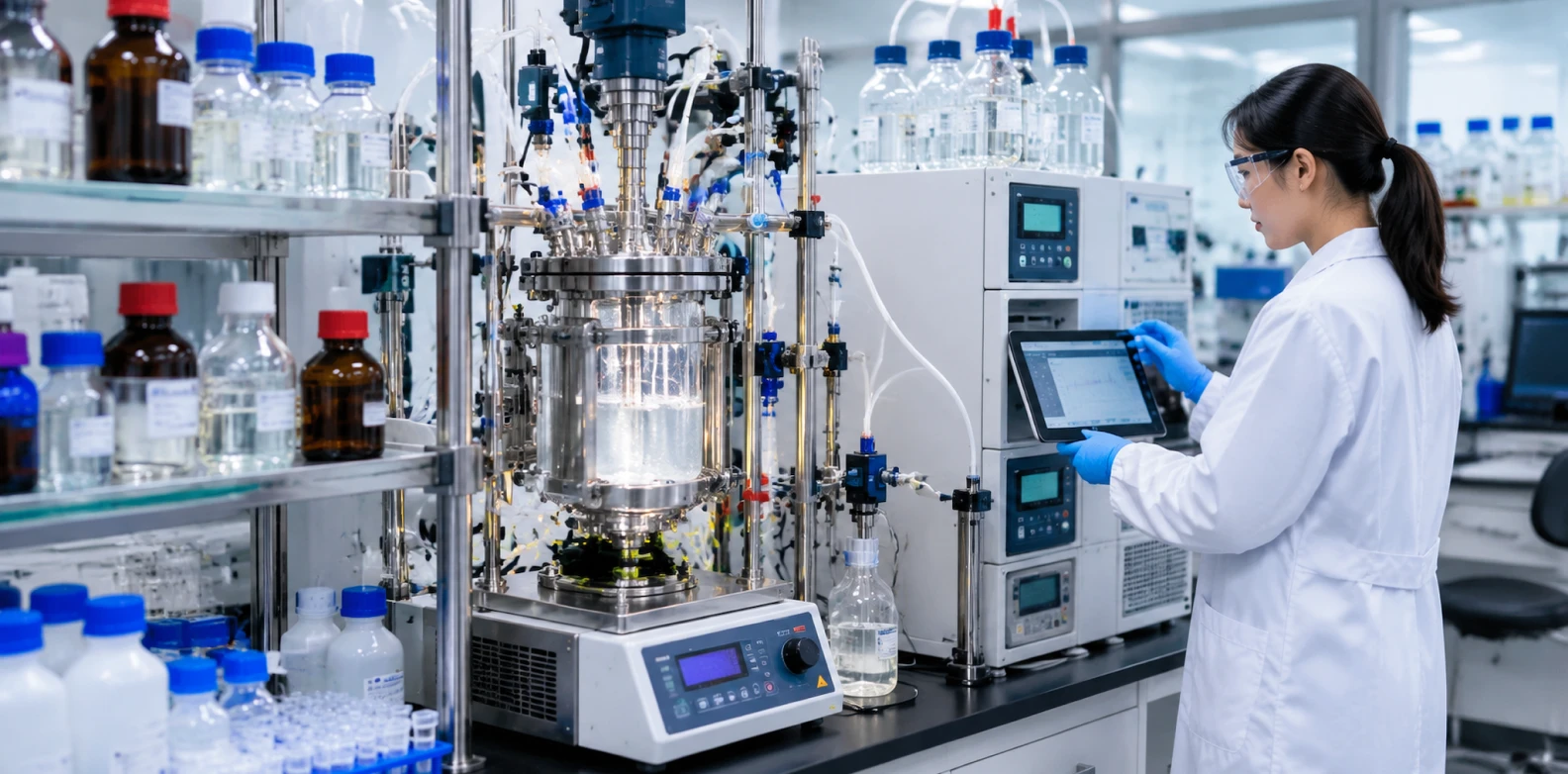
Impurity Profiling and Specification Setting
Peptide impurities are broadly categorized into process-related and product-related variants. Process-related impurities include residual organic solvents (e.g., DMF, NMP, Acetonitrile), elemental impurities from metal catalysts, and residual TFA. Product-related impurities are structurally related to the target peptide and include deletion sequences, truncated fragments, insertion sequences, and oxidation products (such as methionine sulfoxide). Furthermore, aspartimide cyclization in Asp-Gly or Asp-Ser motifs frequently generates beta-aspartyl isomers.
Early-stage clinical filings must establish preliminary specifications based on the actual batch used in the preclinical Good Laboratory Practice (GLP) toxicology studies. If a specific deletion sequence was present at 0.8% in the toxicology batch without adverse effects, the clinical specification can generally be justified at or below that threshold. Partnering with a facility capable of exhaustive drug peptide impurities characterization via high-resolution mass spectrometry is essential for setting scientifically justifiable acceptance criteria that satisfy FDA reviewers.
Analytical Method Validation
Analytical procedures used for batch release must undergo phase-appropriate validation. While comprehensive ICH Q2(R2) validation is typically required prior to Phase III and NDA/BLA submission, Phase I/II methods must rigorously demonstrate specificity, linearity, and limit of quantitation (LOQ). Proving method specificity relies on certified peptide impurities reference standards. Analysts spike the target API batch with precisely synthesized standards of known degradation products and deletion sequences to prove that the RP-HPLC method successfully achieves baseline resolution between the active compound and closely related impurities.
Stability Studies and Forced Degradation
IND submissions require robust stability data proving that the peptide API remains within established specifications throughout the intended clinical trial period. The CMC package must include real-time stability mapping at the intended storage temperature (typically -20°C or 2-8°C) and accelerated stability data.
Crucially, regulatory bodies mandate forced degradation (stress testing) studies for Phase I filings. These studies expose the peptide to extreme conditions, including acidic and basic hydrolysis, thermal stress, oxidative stress (using hydrogen peroxide), and intense photolysis. Forced degradation elucidates the molecule's primary degradation pathways, demonstrating that the chosen analytical methods are truly stability-indicating and capable of detecting degradants that may form during drug product manufacturing or clinical storage.
Leveraging Integrated CDMO Partnerships
Executing a flawless CMC and DMF strategy requires seamless alignment between chemical engineering and regulatory affairs. A specialized peptide CDMO equipped with dedicated in-house regulatory teams can author and maintain the DMF concurrently with process development. This parallel workflow prevents regulatory bottlenecks and minimizes the gap between final API batch release and IND submission.
Furthermore, maintaining process continuity is vital. Selecting a partner capable of executing rapid custom peptide synthesis for preclinical screening and subsequently scaling that exact chemical route to cGMP manufacturing ensures that the impurity profile remains consistent. Process-induced variations resulting from switching manufacturers mid-development often trigger clinical holds and require costly bridging toxicology studies. A robust, single-source CMC strategy ensures that clinical timelines are met with uncompromising molecular quality and complete regulatory compliance.
-

Synpeptide
peptide-focused CRO/CDMO company
The SynPeptide Research Team brings together scientists specializing in peptide synthesis, purification, and analytical characterization. Drawing on hands-on laboratory experience across custom and catalog peptides, the team shares evidence-based insights for researchers, formulators, and product developers. All content is reviewed against current scientific literature and internal quality-control data, reflecting SynPeptide's commitment to accuracy, reproducibility, and the responsible communication of peptide science.