How Custom Peptide Synthesis Works
Custom peptide synthesis means building a peptide chain one amino acid at a time, following the exact sequence a customer supplies. The two main industrial routes are solid-phase peptide synthesis (SPPS) and liquid-phase peptide synthesis (LPPS). Most custom orders today run on SPPS because it is fast, scriptable on automated synthesizers, and easy to purify between steps.
The SPPS Cycle, Step by Step
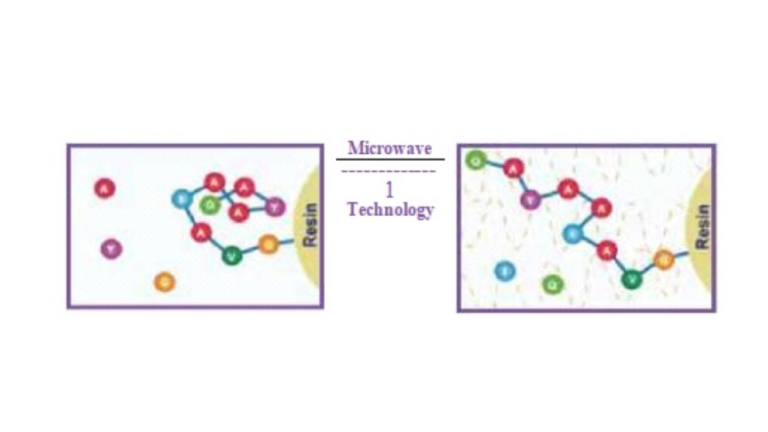
In SPPS the first amino acid is anchored to an insoluble resin bead, and the chain grows from the C-terminus toward the N-terminus through repeated cycles of deprotection and coupling.
- Resin loading — the C-terminal amino acid is attached to a solid resin support; the resin choice depends on whether a C-terminal acid or amide is needed.
- Deprotection — the temporary protecting group (usually Fmoc) on the alpha-amino group is removed with base, exposing a free amine for the next coupling.
- Coupling — the next protected amino acid is activated and joined to the resin-bound chain, forming a new peptide bond. Excess reagent drives the coupling close to completion.
- Washing — the resin is rinsed with solvent to clear excess reagents and byproducts. Filtration alone cleans the chain at every cycle, which is the core advantage of SPPS.
- Repeat — the deprotection, coupling, and washing steps run again for each residue until the full sequence is assembled.
- Cleavage and global deprotection — the finished peptide is cut from the resin and all side-chain protecting groups come off, usually with a TFA cocktail.
- Purification and QC — the crude peptide is purified by reverse-phase HPLC and confirmed by mass spectrometry for identity and purity.
Fmoc vs Boc Chemistry
SPPS uses one of two protecting-group strategies: Fmoc/tBu or Boc/Bzl. Fmoc chemistry is the current standard for most custom work because it runs under milder conditions: the Fmoc group comes off with a base such as piperidine, and final cleavage uses TFA rather than the hazardous HF that Boc/Bzl requires. We use Fmoc-based SPPS as the default for the majority of custom orders, and switch to LPPS or hybrid routes when the sequence calls for it.
What Makes a Sequence Hard to Build
A few features predict trouble before synthesis starts. Long hydrophobic stretches make the growing chain fold and clump on the resin, which stalls coupling. Sequences past roughly 50 residues lose yield as small per-step losses add up. Multiple cysteines need controlled, regioselective disulfide formation so the correct bridges pair up. Motifs such as Asp-Gly are prone to aspartimide side reactions. We screen for these patterns up front and adjust the route, the coupling reagents, or the protecting-group scheme to keep purity high.
Choosing the Right Purity
Match the grade to the experiment. Crude and above-75% peptides suit early screening, ELISA, and immunization. Above 90% to 95% covers most quantitative assays and structure-function work. Above 95% to 98% is the right call for cell-based assays, in vivo studies, SAR, and any pharmaceutical development, where a stray deletion sequence can skew the result. When you are not sure, send the application along with the sequence and we will recommend a grade.
All peptides are supplied for research, analytical, and pharmaceutical development use.