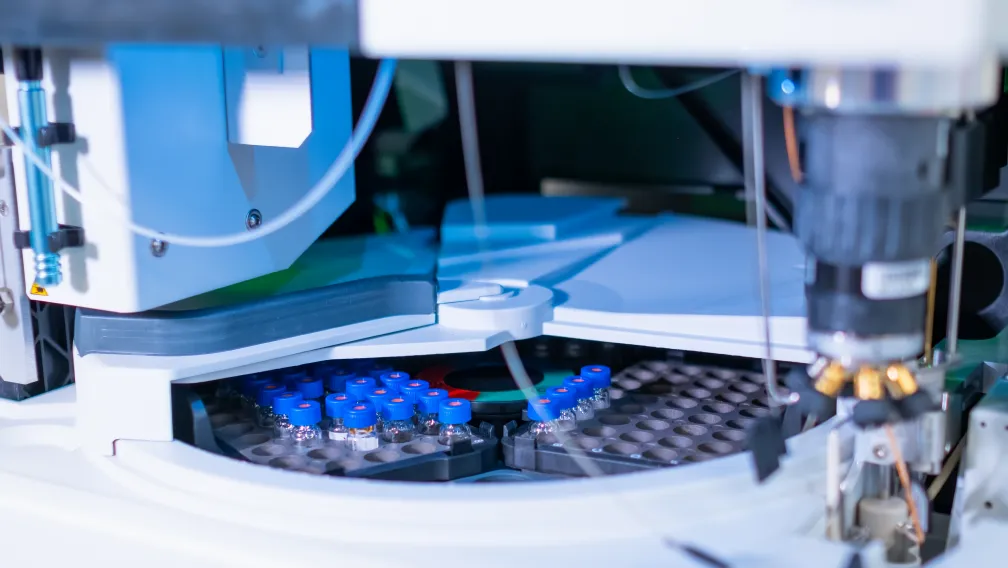
A freeze-dried peptide does you no good until it is fully in solution. Before any assay, HPLC run, or binding study, the powder has to dissolve completely and stay dissolved, and how easily that happens is set mostly by the sequence itself — its net charge and how many water-hating residues it carries. The practical approach is straightforward: read the solubility off the sequence, start with water, then step to an acidic, basic, or organic solvent based on charge, and always test a small aliquot before you commit the whole vial. This guide covers the prediction rules, a solvent decision path, a working protocol, and how to handle oxidation-prone and gel-forming sequences without wasting material.
What controls peptide solubility
Two properties do most of the work: net charge and hydrophobic content. A peptide carrying more acidic residues than basic ones is acidic and tends to dissolve in basic conditions. One with more basic residues is basic and dissolves in acidic conditions. A peptide with balanced or few charges is neutral and often needs an organic solvent. On top of charge, the fraction of non-polar residues matters — a sequence packed with hydrophobic amino acids resists water whatever its charge says.
Two other factors are easy to overlook. The counterion counts: most synthetic peptides come off preparative HPLC as a trifluoroacetic acid (TFA) salt, and residual salts and impurities in the lyophilised cake shift how the powder behaves. A hygroscopic sequence can also pull in moisture the moment the vial is opened cold. None of this changes the sequence rules below, but it explains why two similar peptides sometimes dissolve differently.
Predict solubility from the sequence
Start by working out the net charge. Score the sequence, add it up, and you have a good first guess at which solvent family to reach for.
| Residue or group | Charge contribution |
| Asp (D), Glu (E) | -1 each |
| C-terminal free acid (-COOH) | -1 |
| Arg (R), Lys (K) | +1 each |
| His (H) | +1 (borderline; fully charged only below about pH 6) |
| N-terminal free amine (-NH2) | +1 |
Sum the values. A negative total means an acidic peptide, a positive total a basic peptide, and a total near zero a neutral peptide. Amidated or acetylated termini remove the matching terminal charge, so account for any modifications before you tally.
Charge is only half the picture. Now look at hydrophobic load. Non-polar residues — Ala, Val, Leu, Ile, Met, Phe, Trp, Pro — push a peptide out of water. As a rule of thumb, the charge-based solvent choice starts to fail once hydrophobic residues pass about half the sequence, when a neutral peptide has under 25% charged residues, or when any peptide has under 10% charged residues. Those sequences usually need an organic solvent from the start. Long stretches of hydrophobic residues also tend to aggregate, which shows up as a cloudy suspension or a gel rather than a clear solution. Tools that score a sequence for hydrophobicity and charge can flag these problem cases before you order.
Choose the right solvent
Always try clean water first — deionized or sterile water, at a low concentration. Short peptides of fewer than five residues almost always dissolve this way, and water keeps other chemicals out of your downstream assay. If water leaves cloudiness, gel, or visible particles after a few minutes, move to a solvent matched to the peptide's charge.
| Peptide type | First choice | If it still will not dissolve |
| Basic (net positive) | 10-30% acetic acid | TFA, under 50 uL, then dilute |
| Acidic (net negative) | PBS at pH 7.4, or 0.1 M ammonium bicarbonate | Ammonium hydroxide, under 50 uL, then dilute |
| Neutral | Acetonitrile, methanol, or isopropanol | Small volume of DMSO, then dilute |
| Highly hydrophobic | Small volume of DMSO | Add a co-solvent; see difficult peptides below |
| Aggregating or gelling | 6 M guanidine hydrochloride or 8 M urea | Sonicate briefly, then dilute slowly |
Whatever concentrated stock you make, add it slowly into your working buffer with gentle, constant mixing. Tipping a strong acid, base, or DMSO stock straight into a large volume can crash the peptide back out at the point of contact. Watch the solution as you dilute so you catch any cloudiness early.
Difficult peptides: oxidation and aggregation
Some residues need extra care. Cysteine, methionine, and tryptophan oxidise in DMSO, so a peptide that contains any of them should not sit in DMSO — use DMF instead when a strong aprotic solvent is needed. Free cysteines are the touchiest case: thiols oxidise to disulfides above pH 7, so a cysteine peptide should be dissolved in a degassed, mildly acidic buffer, and basic solvents such as ammonium hydroxide should be avoided. Store oxidation-prone peptides under an inert atmosphere and keep the vial closed except when in use.
Peptides that gel are fighting hydrogen-bond networks between chains. A chaotrope — 6 M guanidine hydrochloride or 8 M urea — breaks those interactions and pulls the peptide into solution, after which you dilute into your assay buffer. If a sequence you order repeatedly gives this trouble, it is usually cheaper to design around it. Adding a charged residue or a solubilising tag, or requesting a specific salt form, can turn a stubborn peptide into an easy one — worth raising with your supplier at the custom synthesis or peptide modification stage rather than after the fact.
Step-by-step protocol
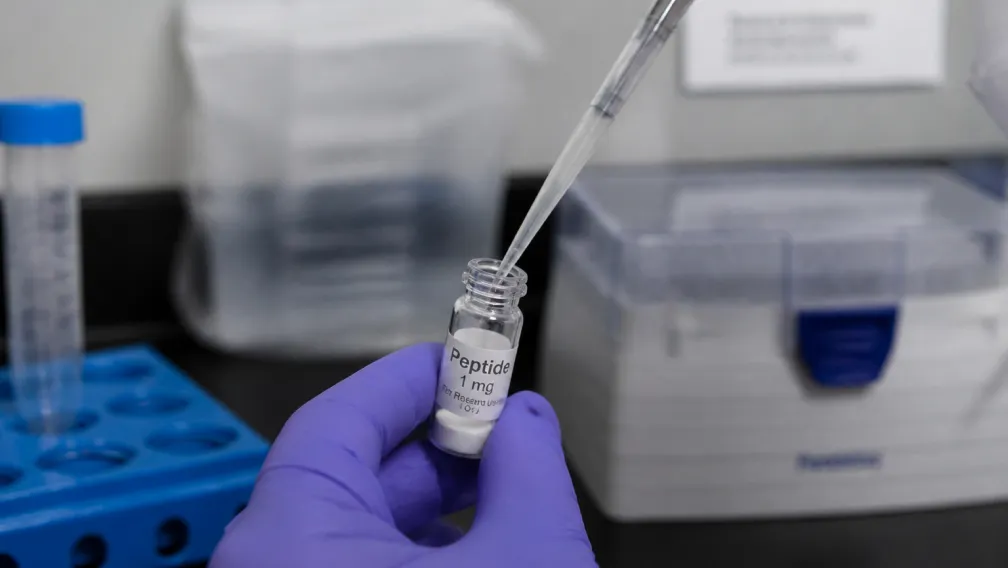
- Bring the sealed vial to room temperature before opening. Cold glass pulls condensation onto the powder, and many peptides are hygroscopic.
- Work out the volume for a stock of roughly 1-2 mg/mL (see below), and pick the solvent from the tables above.
- Run a solubility test on a small aliquot first. Never dissolve the whole vial until you know the solvent works.
- Add the solvent gently down the inside wall of the vial. Do not squirt it directly onto the cake — that fragments the powder and creates clumps.
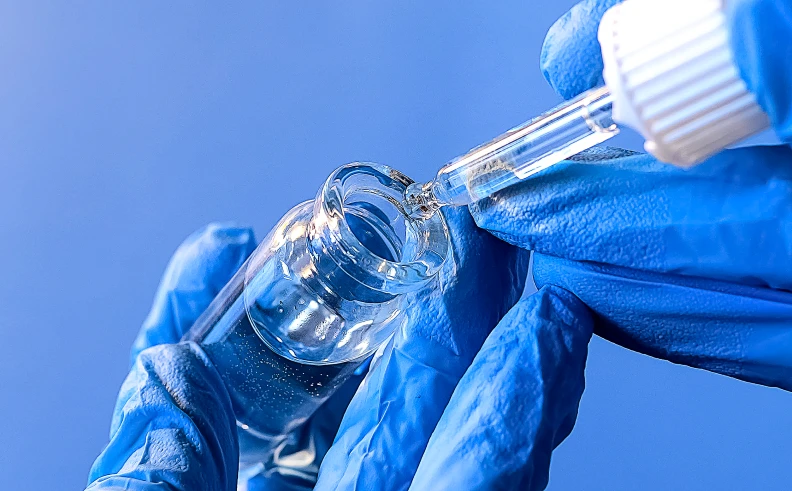
5.Swirl or roll the vial slowly. Brief sonication helps stubborn powder. Avoid vigorous shaking or vortexing, which foams the solution and can damage the peptide.
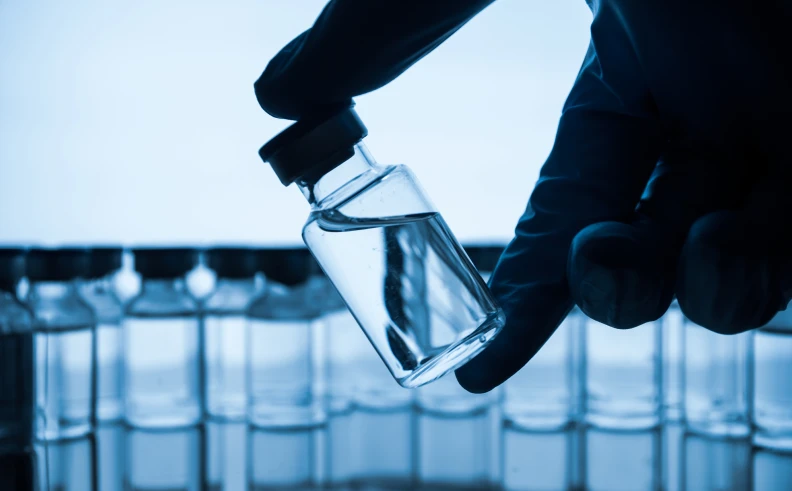
6.Hold the vial to the light. A good solution is clear and free of particles. Cloudiness, a gel, or floating material means the solvent is wrong — go back to the tables.
7.Dilute the concentrated stock slowly into your working buffer with gentle mixing.
8.Label the vial with name, concentration, and date, then aliquot and store as below.
Concentration and net peptide content
A stock around 1-2 mg/mL works well for most bench work. It is concentrated enough that you add only small volumes to an assay — usually under 100 uL — which keeps any acid, base, or organic solvent from the stock at a level that will not interfere. To find the volume for a given amount, divide the mass you need by the stock concentration: volume (mL) = mass (mg) / concentration (mg/mL).
One accuracy point that trips people up: the powder weight is not all peptide. A lyophilised peptide includes counterions, bound water, and residual salts, so the actual peptide can sit well under the gross weight. For quantitative work, use the net peptide content from the certificate of analysis rather than the weighed powder, or your concentrations will read high. Purity and net content sit alongside solubility in what decides whether a peptide performs, which is why they belong on every catalog peptide COA.
Storing peptides after dissolving
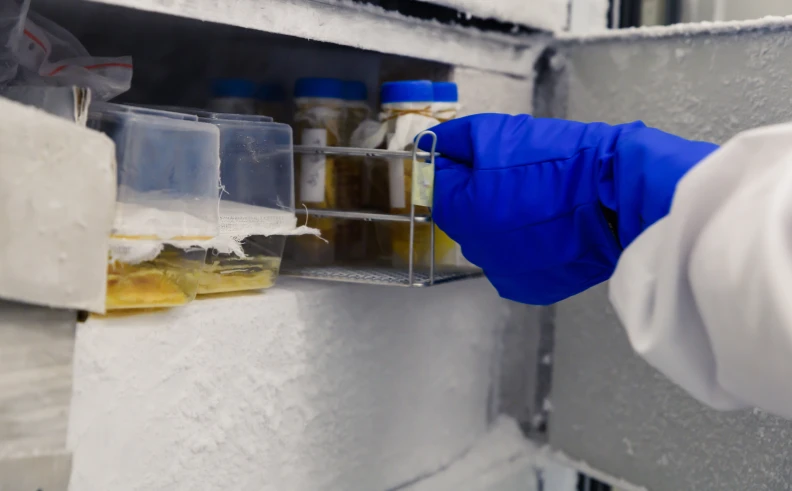
Keep lyophilised peptide sealed and dry at -20 C; that dry, frozen state is what gives the powder its long shelf life. Once a peptide is in solution it is far less stable, so aliquot it into single-use volumes and store at -80 C, and avoid repeated freeze-thaw cycles that degrade it. Peptides containing methionine, cysteine, or tryptophan should be kept under an oxygen-free atmosphere. Reconstituted aqueous solutions do not last indefinitely, so make only what you will use or freeze the rest straight away.
When solubility still will not cooperate
Solubility comes down to sequence, but salt form and impurities move it too, which is why a sequence that looks fine on paper can still resist. The fastest way past guesswork is a solubility test report, or a recommended solvent listed on the COA. At SynPeptide we characterise every batch by HPLC and mass spectrometry and can supply solvent guidance with the delivery, and for sequences that are inherently hard to dissolve we can adjust the salt form — exchanging TFA for acetate is common for cell-based and in vivo research — or build in a solubilising modification during synthesis. For the chemistry behind the salt form and how peptides reach the vial in the first place, see our guide on how peptides are made.
Talk to our peptide team
Working with a sequence that fights you? Send us the sequence, the purity and quantity you need, and any modifications, and we will confirm the solvent, the salt form, and the timeline, and flag any solubility or oxidation risks before synthesis starts. Reach the team at peptide@synpeptide.com.
FAQ
How do you dissolve a peptide?
Bring the sealed vial to room temperature, then add a small volume of clean solvent — start with deionized or sterile water — down the inside wall of the vial and swirl gently. Test a small aliquot first. If water does not work, switch to a solvent matched to the peptide's net charge: dilute acetic acid for basic peptides, a mild base for acidic peptides, or an organic solvent such as acetonitrile or DMSO for neutral and hydrophobic ones. Then dilute the stock slowly into your assay buffer.
What is the best solvent for dissolving peptides?
There is no single best solvent; it depends on the sequence. Water is the first choice because it keeps other chemicals out of the experiment, and short or highly charged peptides usually dissolve in it. Basic peptides take dilute acetic acid, acidic peptides take a mild base such as ammonium bicarbonate, and neutral or hydrophobic peptides need an organic solvent like acetonitrile, methanol, or DMSO. Match the solvent to the charge and hydrophobicity you read off the sequence.
Why will my peptide not dissolve in water?
Most likely the sequence is too hydrophobic or its charge is unbalanced. Peptides with a high fraction of non-polar residues resist water and need an organic solvent, and strongly acidic or basic peptides often need a matching base or acid to enter solution. Adding more water to an undissolved peptide only dilutes it further. Go back to a solvent matched to the peptide's charge, or use a small volume of organic solvent and then dilute.
Can I dissolve peptides in DMSO?
Yes, for hydrophobic or neutral peptides DMSO is often effective — add a small volume, dissolve, then dilute into buffer. The exception is any peptide containing cysteine, methionine, or tryptophan, because DMSO oxidises those residues; for cysteine-containing sequences, use DMF instead. Keep DMSO to the smallest volume that works so it does not carry into and interfere with downstream assays.
How do I dissolve a hydrophobic peptide?
Skip water and start with an organic solvent. Acetonitrile, methanol, or isopropanol suit moderately hydrophobic peptides; a small volume of DMSO handles strongly hydrophobic ones, with DMF as the substitute when cysteine, methionine, or tryptophan is present. If the peptide gels, add a chaotrope such as 6 M guanidine hydrochloride or 8 M urea to break up the aggregation. Once dissolved, dilute slowly into your working buffer with gentle mixing.
What concentration should I dissolve my peptide at?
A stock of about 1-2 mg/mL suits most bench work. It is concentrated enough that you add only small volumes to an assay, which limits how much solvent carries over. Calculate the volume by dividing the mass you need by the target concentration. For accurate concentrations, base the calculation on the net peptide content from the COA, not the gross powder weight, since counterions and water make up part of the lyophilised mass.
How should I store a peptide after dissolving it?
Aliquot the solution into single-use volumes and store at -80 C, and avoid repeated freeze-thaw cycles. Reconstituted peptides are much less stable than the dry powder, so make only what you need or freeze the rest immediately. Keep lyophilised peptide sealed and dry at -20 C, and store oxidation-prone sequences containing methionine, cysteine, or tryptophan under an inert atmosphere.
How do I dissolve a peptide that contains cysteine?
Cysteine peptides oxidise easily, so avoid DMSO and avoid basic solvents such as ammonium hydroxide, both of which promote disulfide formation. Dissolve the peptide in a degassed, mildly acidic buffer, and when a strong aprotic solvent is needed use DMF rather than DMSO. Keep the solution under an inert atmosphere and use it promptly to limit oxidation.
-

Synpeptide
peptide-focused CRO/CDMO company
The SynPeptide Research Team brings together scientists specializing in peptide synthesis, purification, and analytical characterization. Drawing on hands-on laboratory experience across custom and catalog peptides, the team shares evidence-based insights for researchers, formulators, and product developers. All content is reviewed against current scientific literature and internal quality-control data, reflecting SynPeptide's commitment to accuracy, reproducibility, and the responsible communication of peptide science.