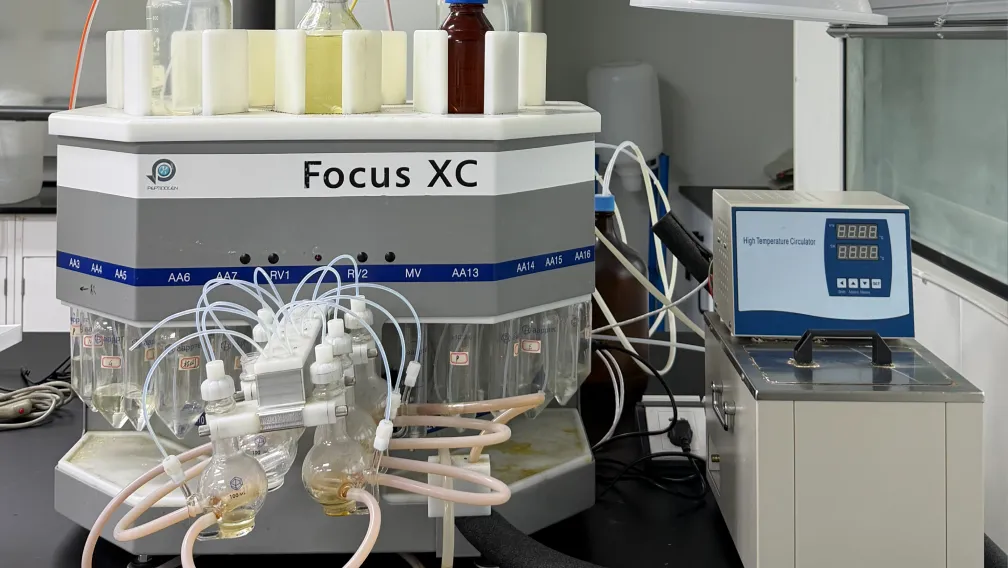
Every shipment of synthetic peptides arrives with a certificate of analysis, and every buyer signs for it. Fewer buyers read it closely enough to catch a mismatch between the document and the vial, or between the data and what their experiment actually needs. A COA condenses the identity, purity, and handling limits of a specific lot into one or two pages, and learning to read it field by field takes less time than troubleshooting a failed assay caused by a misunderstood specification. This guide walks through each section of a standard peptide COA, explains how to interpret the attached chromatogram and mass spectrum, lists the red flags that justify a query to the supplier, and describes how to verify documentation after receipt. It applies to material ordered through custom peptide synthesis and to off-the-shelf catalog peptides alike.
What a Peptide COA Is and What It Is Not
A certificate of analysis is a lot-specific test record. It reports the results obtained when the manufacturer's quality control unit tested that particular batch against its written specification. Three implications follow. First, a COA is only as strong as the specification and methods behind it: a purity claim measured by a validated, documented method carries more weight than a number without a method block. Second, a COA describes one lot. Data from a previous batch, or from a representative batch, is not a substitute. Third, a COA is a statement of results at the time of testing. It does not guarantee the condition of the material after months of poor storage, which is why stability and storage practice on the receiving end matters as much as release data.
The Identity Section
The header of a COA establishes what the material is supposed to be. Check the following fields before anything else:
- Product name and sequence. The amino acid sequence should be written in full, in standard one-letter or three-letter code, with terminal states indicated (free acid or amide at the C-terminus, free amine or acetyl at the N-terminus) and any modifications such as phosphorylation, biotinylation, fluorescent labels, or cyclization explicitly named with their positions.
- Molecular formula and theoretical molecular weight. These derive from the sequence and define the value the mass spectrum must match.
- Lot or batch number. This identifier ties the document to the vial label and to the manufacturer's retained samples and production records. It must match the label on the container you received.
- Quantity and fill information. The net weight per vial, where stated, should be read together with the net peptide content discussed below.
Theoretical Versus Observed Molecular Weight
The COA lists a calculated molecular weight for the target sequence and an observed value from mass spectrometry. For most peptides, ESI-MS produces a series of multiply charged ions, and the software deconvolutes these into a neutral mass; MALDI-TOF typically shows the singly protonated molecule. Agreement within the mass accuracy of the instrument, commonly ±1 Da for routine work on peptides of moderate size, confirms identity. A systematic offset points to a real structural difference: a mass 42 Da higher suggests an unexpected acetyl group, 16 Da higher suggests oxidation, and 18 Da lower suggests a cyclization or dehydration event. An observed mass that matches the theoretical value is necessary evidence of identity, though it cannot distinguish between certain isomers.
Reading the Purity Section and the Chromatogram
The purity entry usually reports a single number, but the attached chromatogram carries the real information. When examining it, work through these points in order:
- Method block. Column type, dimensions, mobile phases, gradient program, flow rate, and detection wavelength (214 or 220 nm for peptide bonds) should all be stated. Without them, the chromatogram cannot be reproduced.
- Main peak. It should dominate the integration table, with a retention time consistent with the method. A symmetrical main peak with a clean baseline on both sides indicates that impurities are genuinely separated rather than hidden underneath.
- Minor peaks. Their number, size, and positions describe the impurity profile. A lot at 98% with one well-resolved 1.5% deletion peak is a cleaner material than a lot at 98% with ten unresolved bumps on the main peak's shoulder, even though the headline numbers match.
- Integration marks. Visible start and end marks show what the software included in the area calculation. Aggressive baseline choices can exclude real impurities from the integration.
For programs that track specific impurities, such as deletion sequences or oxidized variants in drug peptide impurity studies, the chromatogram also serves as the reference fingerprint against which future lots are compared.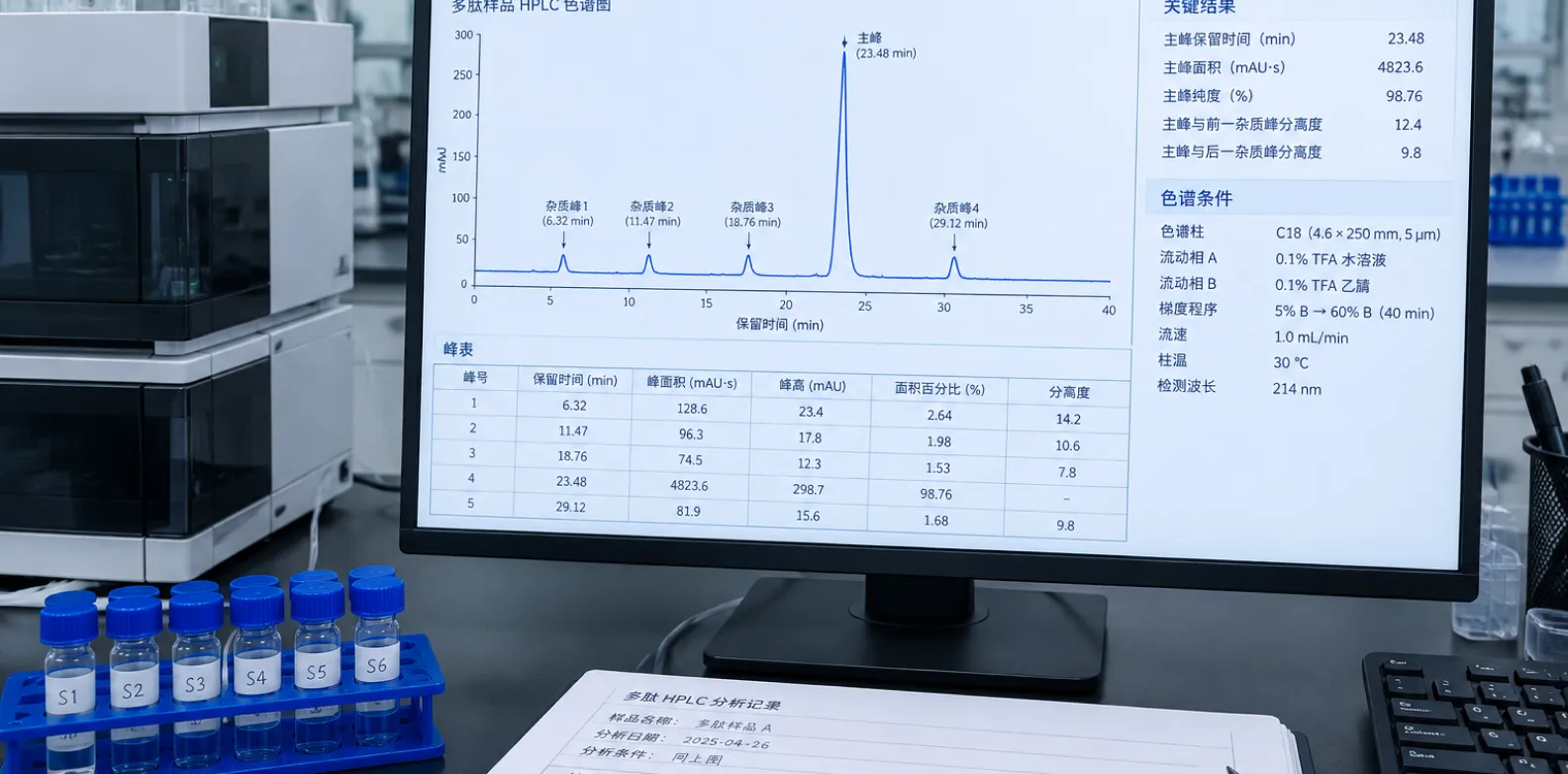
Reading the Mass Spectrum
Where the chromatogram reports purity, the spectrum reports identity. On an ESI spectrum, look for a coherent series of charge states whose deconvoluted mass matches the theoretical value. Multiple unrelated charge series suggest a mixture. On a MALDI spectrum, look for a single dominant [M+H]+ signal with the expected isotope pattern. Sodium and potassium adducts at +22 and +38 Da are common and harmless; a persistent peak at the mass of a deletion or truncated sequence deserves a question to the supplier even when HPLC purity passes specification.
Physical and Chemical Test Entries
Beyond purity and identity, a complete peptide COA carries a block of quantitative tests. The table below summarizes what each entry measures and why it matters.
| COA entry | Method | What it tells you |
|---|---|---|
| Appearance | Visual | White to off-white fluffy powder is typical; discoloration suggests oxidation or contamination |
| Solubility | Visual/gravimetric | Confirms the material dissolves in the stated solvents at the stated concentration |
| Water content | Karl Fischer titration | Bound water typically runs 3-10%; needed for accurate net content calculations |
| Counterion content | Ion chromatography | TFA or acetate levels; affects net peptide content and cell-based assays |
| Net peptide content | Amino acid analysis | The actual peptide mass fraction of the powder, commonly 60-85% |
| Residual solvents | Gas chromatography | Acetonitrile, ether, and related solvents remaining from purification and lyophilization |
Net peptide content deserves particular attention. A vial labeled 10 mg with 75% net content delivers 7.5 mg of peptide. Experiments that depend on molar concentration should calculate working concentrations from the net content, not the gross weight.
Microbiological and Application-Specific Entries
Material destined for cell culture or animal work may carry an endotoxin entry measured by the LAL method, reported in EU/mg. Peptides synthesized by standard chemical routes rarely show meaningful endotoxin, but lyophilization water, containers, and handling can introduce it, so a stated result with a method reference is preferable to an assumed one. Peptides produced under GMP for clinical programs, typically through a peptide CDMO, add further entries such as bioburden, specified impurity limits with identification thresholds, and validated method references, which scale up into the full documentation used in large-scale peptide synthesis.
Administrative Fields That Matter
The final block of a COA looks bureaucratic and is easy to skip, yet it determines whether the document can be trusted and acted upon:
- Manufacturing date and test date. A long gap between them raises the question of whether the material was re-tested or simply re-labeled.
- Retest or expiry date. Peptides assigned a retest date should be re-qualified if used beyond it, particularly sequences prone to oxidation or deamidation.
- Storage conditions. The stated conditions, typically -20°C protected from light and moisture, define how the material must be held to keep the release data valid.
- QC approval. A signature, printed name, or electronic authorization from the quality unit, with a date, closes the document. An unsigned COA is a draft.
Red Flags That Justify a Query
Most COAs from established suppliers are complete and consistent. When they are not, the following patterns justify contacting the supplier before the material goes into an experiment:
- A purity number with no chromatogram attached.
- A chromatogram with no method block, or detection reported only at 280 nm.
- Theoretical values presented where measured values should be, such as a molecular weight with no spectrum.
- A lot number on the certificate that does not appear on the vial label.
- A single generic certificate reused across multiple lots or products.
- A test date that predates the manufacturing date, or that sits years before the shipping date with no retest record.
- No net peptide content available even on request, for a product sold by weight.
Verifying Documentation After Receipt
Reading the COA ends at the bench. On receipt, confirm that the vial label matches the document, inspect the powder for the stated appearance, and run a solubility spot check before committing the full vial. For critical lots, an in-house or third-party LC-MS run under your own method verifies both identity and purity independently. Retain a small archive sample of each lot so that any later discrepancy can be investigated against material rather than memory. Suppliers confident in their QC welcome this practice; our own documentation packages are built to survive it.
Getting the Documentation You Need
When you request a quotation, state which tests you require beyond the standard HPLC and MS package — net peptide content, counterion assay, endotoxin, or a full impurity profile. Defining the analytical package at the ordering stage costs little and prevents disputes later. Submit your sequence and testing requirements through our custom peptide synthesis page, or contact us to discuss a documentation package matched to your application.
-

Synpeptide
peptide-focused CRO/CDMO company
The SynPeptide Research Team brings together scientists specializing in peptide synthesis, purification, and analytical characterization. Drawing on hands-on laboratory experience across custom and catalog peptides, the team shares evidence-based insights for researchers, formulators, and product developers. All content is reviewed against current scientific literature and internal quality-control data, reflecting SynPeptide's commitment to accuracy, reproducibility, and the responsible communication of peptide science.