A peptide that refuses to dissolve is one of the most common problems in peptide research, and one of the most preventable. Solubility is determined by the amino acid sequence, and in most cases the correct solvent can be predicted before the vial is opened. This guide gives the working procedure we recommend: how to read a sequence for charge and hydrophobicity, which solvent to try first, how to dissolve difficult hydrophobic sequences step by step, and what to do when a peptide precipitates during dilution.
Why Some Peptides Resist Dissolving
Two sequence properties control solubility. The first is net charge. Charged residues repel each other in solution, keeping molecules apart and hydrated; a peptide near zero net charge aggregates more easily. Every peptide has an isoelectric point (pI), the pH at which its net charge is zero, and solubility is lowest at or near that pH. Moving the solution pH away from the pI increases net charge and improves dissolution.
The second property is hydrophobicity. Residues such as Leu, Ile, Val, Phe, Trp, and Met carry water-avoiding side chains. As a working rule, peptides with more than 50% hydrophobic residues are poorly soluble in aqueous solution, while sequences with more than 25% charged residues (Asp, Glu, Lys, Arg, His) usually dissolve in water or buffer. Very short peptides under five residues are typically water-soluble unless the entire sequence is hydrophobic.
Step 1: Read the Sequence Before Choosing a Solvent
A quick charge estimate takes less than a minute and usually identifies the right starting solvent:
- Assign -1 to each acidic residue: Asp (D), Glu (E), and the free C-terminal carboxyl group
- Assign +1 to each basic residue: Lys (K), Arg (R), His (H), and the free N-terminal amino group
- Sum the values to get the approximate net charge at neutral pH
The result sorts the peptide into one of three categories:
| Sequence Profile | First Solvent to Try | If It Does Not Dissolve |
|---|---|---|
| Net charge positive (basic peptide) | Water or neutral buffer | 10–30% acetic acid; a small volume of TFA as a last resort |
| Net charge negative (acidic peptide) | Water or neutral buffer | Dilute ammonium hydroxide or 10% ammonium bicarbonate |
| Net charge near zero, hydrophobic | Small volume of DMSO, DMF, or acetonitrile | Higher organic fraction, then slow aqueous dilution |
| Contains free cysteine | Degassed acidic buffer below pH 7 | Add a reducing agent such as DTT; avoid basic conditions |
| Aggregation-prone (β-sheet forming) | Standard solvent for its charge class | 6 M guanidine hydrochloride or 8 M urea to break aggregates |
One important exception: acidic peptides containing cysteine should not be dissolved in basic solution. Above pH 7, free thiols oxidize rapidly into disulfide bonds, which changes the molecule you are working with. Use degassed acidic buffer instead.
Salt form influences behavior here as well. Peptides delivered as trifluoroacetate salts—especially sequences rich in Arg and Lys—tend to dissolve more readily at neutral pH than the same sequences in other salt forms, because the counterion keeps basic sites protonated and charged. If a basic peptide dissolves poorly in water, a small amount of dilute acetic acid usually resolves it within a minute.
Step 2: Dissolve a Small Test Amount First
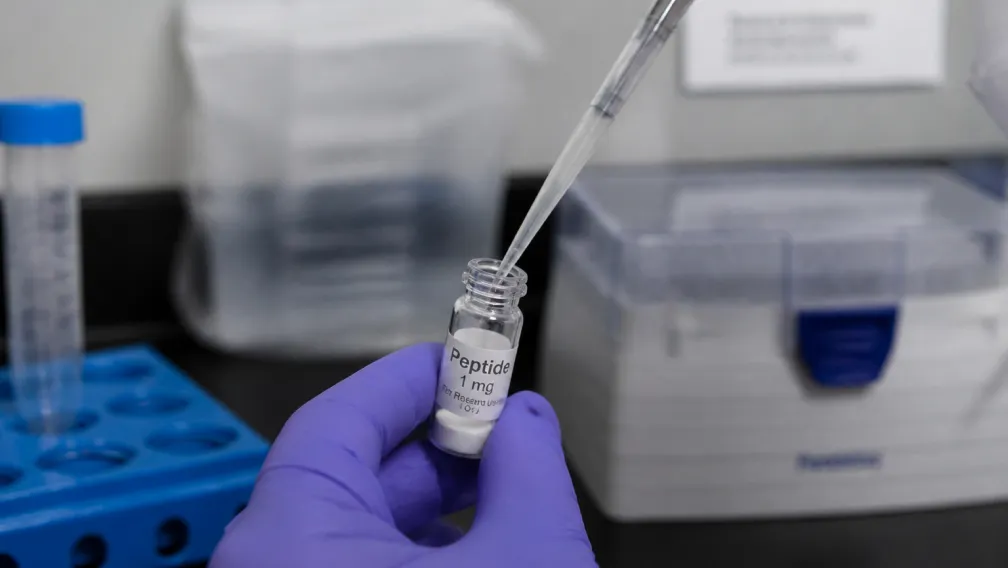
Never commit the entire vial to an untested solvent. Take a small aliquot, confirm dissolution, and only then prepare the full stock. Three handling details protect the material during this step:
- Warm the sealed vial to room temperature before opening. Opening a cold vial draws condensation into the hygroscopic powder, changing its mass and stressing oxidation-sensitive residues.
- Correct for net peptide content. The weighed solid includes counterions and water, so the true peptide mass is lower than the label weight. The calculation is covered in our peptide purity and net content guide.
- Add solvent gently and avoid aggressive vortexing. A peptide solution that turns cloudy after sonication is a suspension, not a solution—centrifuge and check before trusting the concentration.
Step 3: Dissolving Hydrophobic Peptides
Hydrophobic sequences need an organic start. The standard procedure is:
- Dissolve the peptide completely in a small volume of 100% DMSO—often 30–50 µl for a difficult sequence
- Add this concentrated stock dropwise into a stirring aqueous buffer, never the other way around
- Watch for turbidity at each addition; cloudiness marks the solubility limit under those buffer conditions
- Brief bath sonication between additions helps break up small aggregates; keep the sample cool to avoid warming
Two constraints apply. First, DMSO oxidizes methionine and cysteine side chains over time, so peptides containing these residues should be started in DMF instead. Second, the final organic fraction must fit the assay. Most cell-based systems tolerate up to about 1% DMSO, with 0.5% a safer working ceiling and a solvent-only control recommended. If the peptide only stays dissolved in pure DMSO and precipitates on any dilution, the problem is compatibility with the aqueous system, and a lower working concentration is usually the realistic answer.
Troubleshooting Common Failures
The peptide dissolves in the first solvent but precipitates when diluted into buffer. The dilution was too fast or the buffer pH sits near the pI. Re-dissolve, then add the stock dropwise into a vigorously stirred buffer, and check whether a small pH shift away from the pI keeps it in solution.
The solution is cloudy or gelled. The material is suspended or aggregated, not dissolved. Centrifuge, discard the pellet assumption, and treat as aggregation-prone: try a chaotrope step (6 M guanidine HCl or 8 M urea), then dilute. Note that chaotropes are incompatible with most biological assays, so this route suits analytical work, not cell experiments.
Nothing works and you need the material back. Lyophilize the failed solution to remove the solvent, then restart with a different solvent system. A failed attempt does not destroy the peptide if it is recovered promptly.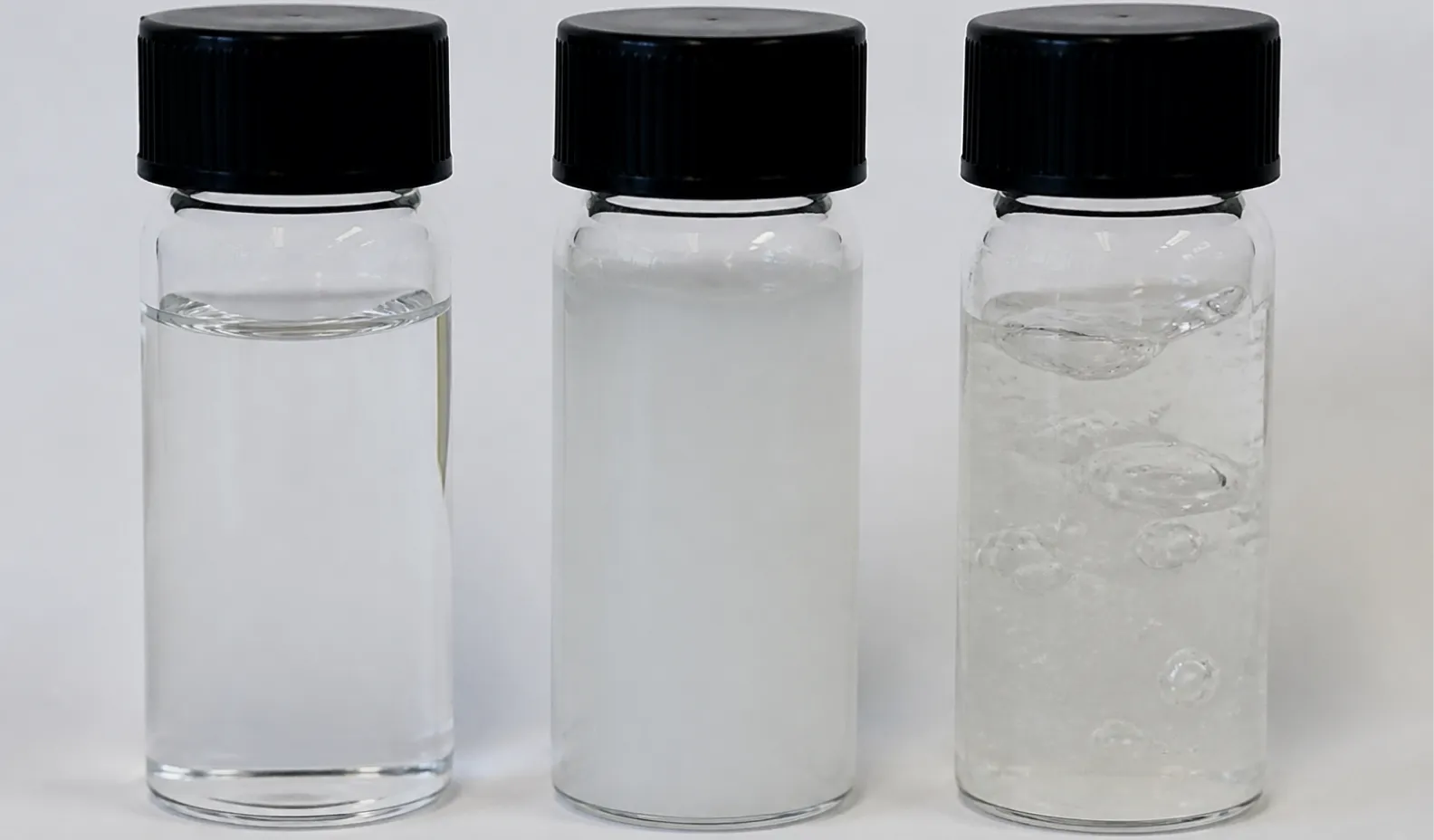
Storage After Reconstitution
Dissolution is only half the problem; a peptide that degrades in solution wastes the work. Reconstituted peptides are far less stable than the lyophilized powder. For use within days, store the solution at 4°C. For anything longer, divide the stock into single-use aliquots and freeze at -20°C or below. Aliquoting is the step that matters most: repeated freeze-thaw cycles degrade peptide quality, and each cycle is avoidable with one extra tube.
Two quieter failure modes deserve attention. Dilute peptide solutions adsorb to ordinary plastic surfaces, which lowers the effective concentration most noticeably at low concentrations—use low-binding tubes and tips for working dilutions. And oxidation-sensitive sequences (Cys, Met, Trp) degrade faster in solution than as powder, so prepare these solutions fresh, use degassed buffers, and minimize the time the container stays open. As a general practice, prepare solutions immediately before use and treat any stock older than a few weeks as suspect unless stability has been verified by HPLC.
The peptide dissolved last month but the stored stock now underperforms. Assume degradation in solution. Oxidation, hydrolysis, and adsorption losses accumulate in stored stocks, and repeated warming of a master stock accelerates all three. Prepare a fresh solution from the lyophilized powder, compare results, and if the fresh material performs normally, retire the old stock. Stocks intended for reuse belong in single-use frozen aliquots, not in a shared tube at 4°C.
When the Sequence Itself Is the Problem
Some sequences cannot be made reliably soluble by solvent selection alone. In those cases the fix belongs to the design stage, before synthesis. Established options include adding two or three polar residues (Lys, Glu) to the N- or C-terminus, substituting individual hydrophobic residues that are not required for activity, and PEGylation to add a hydrophilic shield. These are standard requests in peptide modification projects and are far cheaper to implement at the design stage than to troubleshoot after delivery. When ordering custom peptide synthesis, flagging the intended buffer system and working concentration up front lets the synthesis team recommend solubility-improving options before the sequence is fixed.
SynPeptide provides solubility guidance with every custom order, including solvent recommendations matched to your downstream assay. If you are working with a sequence that has resisted standard approaches, send it to our technical team for a solubility assessment before you commit material.
-

Synpeptide
peptide-focused CRO/CDMO company
The SynPeptide Research Team brings together scientists specializing in peptide synthesis, purification, and analytical characterization. Drawing on hands-on laboratory experience across custom and catalog peptides, the team shares evidence-based insights for researchers, formulators, and product developers. All content is reviewed against current scientific literature and internal quality-control data, reflecting SynPeptide's commitment to accuracy, reproducibility, and the responsible communication of peptide science.