Chemical synthesis offers two established routes for building a peptide chain: solid-phase peptide synthesis (SPPS) and liquid-phase peptide synthesis (LPPS). Both methods form the same amide bonds, but they handle intermediates, purification, and scale in fundamentally different ways. Choosing the wrong route can double the cost of goods, extend a timeline by months, or yield a crude product that cannot be purified to specification. This guide compares SPPS and LPPS on reaction mechanics, scalability, cost, and sequence fit, and explains when a hybrid route combining both methods is the correct answer. For a step-by-step overview of the full production workflow, see our article on how peptides are made.
What Is Solid-Phase Peptide Synthesis (SPPS)?
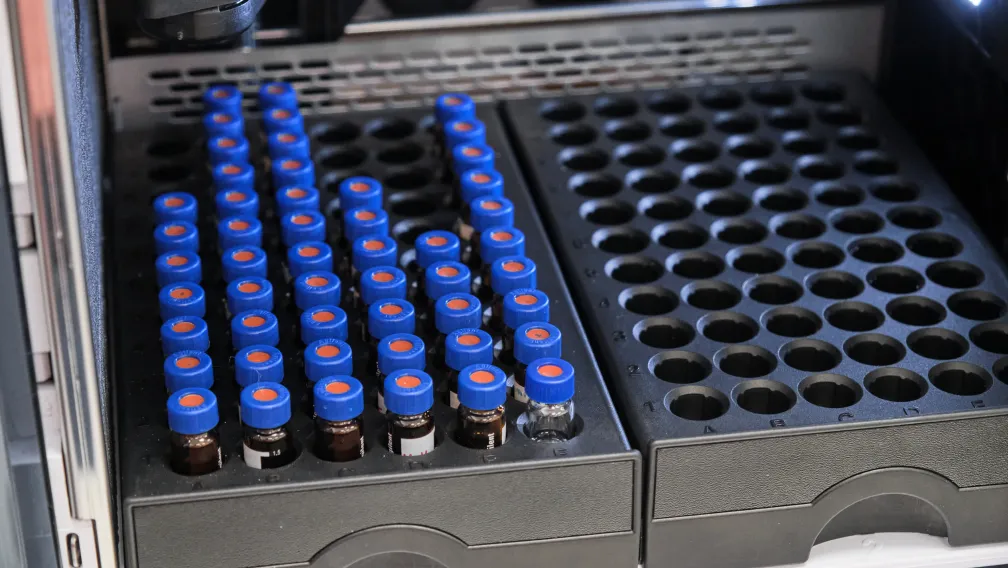
In SPPS, the C-terminal amino acid is anchored to an insoluble polymer resin through a cleavable linker. The chain is assembled from the C-terminus to the N-terminus, one residue at a time. Each cycle has two operations: removal of the temporary Nα protecting group (Fmoc with piperidine, or Boc with trifluoroacetic acid), then coupling of the next protected amino acid with an activating reagent such as HBTU, HATU, or DIC. Because the growing chain stays bound to the resin, excess reagents and soluble by-products are removed by filtration and washing. No intermediate isolation is required.
After the final residue is coupled, the peptide is cleaved from the resin and the side-chain protecting groups are removed in a single step, usually with a TFA-based cocktail. The crude peptide is then purified, most commonly by preparative reversed-phase HPLC.
Strengths of SPPS:
- Speed. Coupling cycles take minutes to under an hour per residue. Microwave-assisted systems shorten cycle times further and improve difficult couplings.
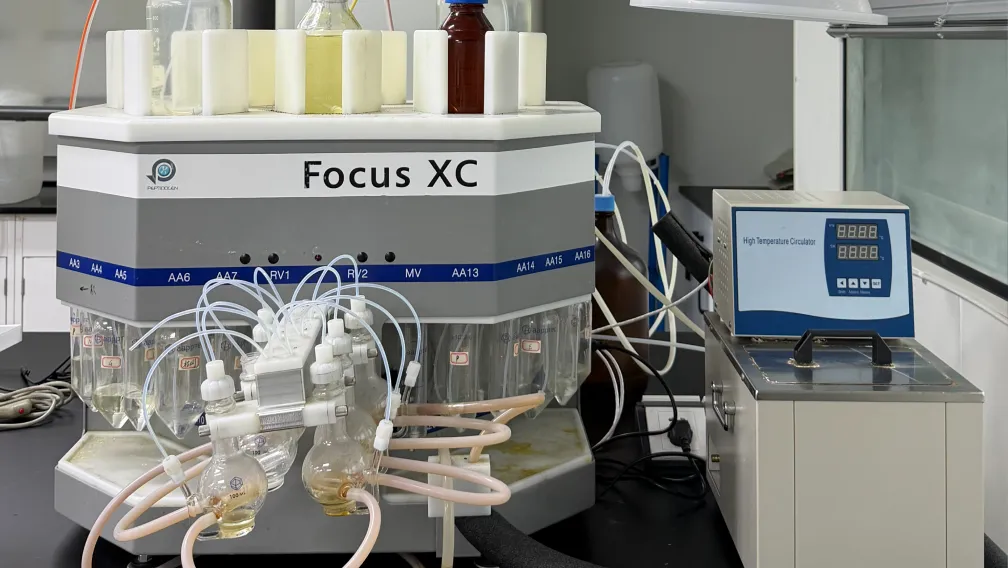
- Automation. Fully automated synthesizers run unattended and can produce dozens of sequences in parallel, which makes SPPS the standard platform for peptide libraries and screening campaigns.
- High per-step yield. Excess reagents drive resin-bound couplings toward completion, and individual coupling yields above 99% are routine for standard residues.
- Sequence flexibility. Non-natural amino acids, labels, and most peptide modifications can be introduced directly during chain assembly.
Limitations of SPPS:
- Each coupling consumes several equivalents of amino acid and activating reagent, plus large wash volumes. At multi-kilogram scale, this raises the cost of goods significantly.
- Hydrophobic stretches can aggregate on the resin, blocking the terminal amine and causing incomplete coupling or deprotection.
- Deletion sequences accumulate with chain length. Purification happens only once, at the end, so a long crude peptide can contain many closely related impurities that are hard to separate.
What Is Liquid-Phase Peptide Synthesis (LPPS)?
LPPS is the classical method of peptide chemistry. All reactions take place in homogeneous solution, without a solid support. Two strategies exist. In stepwise elongation, residues are added one at a time as in SPPS. In convergent synthesis, protected fragments of 5–15 residues are prepared separately and then coupled together. After each step or each fragment coupling, the intermediate is isolated and purified before the synthesis continues.
Strengths of LPPS:
- Intermediate purification. Partial sequences can be purified and fully characterized at every stage. Impurities are removed before they can propagate, so the final coupling starts from material of verified purity.
- Moderate reagent excess. Homogeneous reactions need far smaller excesses than resin-bound chemistry, which lowers material consumption and improves the economics of short peptides produced at volume.
- Direct monitoring. Reaction progress can be followed directly by HPLC or TLC, because the reaction mixture itself can be sampled and analyzed.
- Scalable purification options. Crystallization or extraction can replace chromatography for suitable intermediates, which reduces purification cost at production scale.
Limitations of LPPS:
- Every isolation step costs time and material. The process is labor-intensive and slow.
- Protected intermediates beyond roughly 10 residues often show poor solubility, which complicates coupling and workup.
- Automation is limited, and no universal protocol exists. Protecting groups, coupling reagents, and solvents must be selected for each sequence, so process development is usually required before production.
SPPS vs LPPS: A Direct Comparison
| Parameter | SPPS | LPPS |
|---|---|---|
| Reaction medium | Insoluble resin (gel phase) | Homogeneous solution |
| Synthesis strategy | Stepwise, C→N | Stepwise or convergent (fragment condensation) |
| Intermediate purification | Not possible; purification only at the end | Routine, after each step or fragment |
| Automation | Fully automated platforms available | Limited; largely manual |
| Synthesis speed | Fast (hours to days) | Slow (days to weeks) |
| Reagent excess | High (typically 2–5 equivalents per coupling) | Moderate |
| Typical sequence length | Up to ~50–60 aa routinely; longer with optimized protocols | Short peptides (<10 aa) or protected fragments |
| Process monitoring | Indirect (test cleavage, Kaiser test) | Direct HPLC analysis of the reaction mixture |
| Best economics | mg–g scale; moderate kg scale for longer sequences | Short peptides at large volume |
Five Factors That Determine the Right Route
1. Sequence Length
Length is the first filter. Below roughly 10 residues, LPPS is a practical option and may be cheaper at volume. Between 10 and 60 residues, SPPS is the default choice because its cycle-based assembly is fast and reliable. Beyond 60–80 residues, a purely stepwise route becomes risky on either platform, and a convergent hybrid strategy is usually required. For long sequences delivered through custom peptide synthesis, route planning at the quotation stage prevents failed synthesis attempts later.
2. Sequence Difficulty and Aggregation
Sequences rich in Val, Ile, Leu, Phe, or β-sheet-forming motifs tend to aggregate during chain assembly. On resin, aggregation blocks the terminal amine and lowers coupling efficiency. Standard countermeasures include low-loading resins, pseudoproline dipeptides, backbone-protecting groups, double coupling, and microwave assistance. If a difficult region still fails after optimization, isolating that region as a solution-phase fragment is often more effective than forcing the full sequence through SPPS.
3. Batch Size and Cost of Goods
At milligram-to-gram scale, speed and flexibility dominate, and SPPS wins almost every comparison. At multi-kilogram scale for a short, simple peptide, LPPS typically delivers a lower cost per kilogram because reagent excess is moderate and intermediates can be purified by crystallization rather than chromatography. For large-scale peptide synthesis of longer sequences, a hybrid route usually gives the best balance of yield, purity, and cost.
4. Modifications and Structural Complexity
Most modifications—acetylation, amidation, phosphorylation, fluorescent labels, biotin, PEGylation—are installed conveniently on resin using orthogonally protected building blocks. Cyclization can be performed on-resin or in solution depending on ring size and sequence flexibility; constrained sequences are covered in our cyclopeptides capability. Final conjugation steps, such as attaching a drug payload or lipid chain, are frequently carried out in solution even when the peptide itself was built by SPPS.
5. Development Stage and Timeline
Discovery work needs speed and parallel capacity, so SPPS is the default. Early clinical material is also usually produced by SPPS or a hybrid route because timelines are tight. Before commercial supply is locked in, the economics of LPPS or fragment condensation should be modeled, because re-qualifying a manufacturing route after registration is expensive and slow.
The Hybrid Route: Fragment Condensation
Most high-volume therapeutic peptides are not produced by a single method. In a hybrid process, protected fragments are built by SPPS, cleaved from the resin with side-chain protection intact, purified and characterized individually, and then coupled in solution. This arrangement combines the speed of SPPS with the intermediate control of LPPS. Deletion sequences are capped at fragment length, so the final assembly starts from verified material.
The 36-residue HIV fusion inhibitor enfuvirtide is a well-documented industrial example: its fragments are prepared on solid support and condensed in solution. For peptides beyond 40–60 residues, a convergent route is frequently the only economical option, because the cumulative yield of a purely stepwise route declines with every additional coupling cycle. A 99% per-step yield still leaves barely 70% theoretical yield after 30 couplings; splitting the same sequence into three fragments recovers most of that loss.
Route Selection Across the Project Lifecycle
The route is rarely a one-time decision. A molecule typically starts on SPPS for discovery and screening, moves through an optimized SPPS or hybrid process for preclinical and early clinical material, and is re-evaluated for LPPS or fragment condensation when commercial volumes justify the process development investment. Planning this transition early avoids re-developing the process and re-qualifying a supplier at the worst possible stage. A peptide CDMO that operates both platforms can carry one molecule from milligrams to kilograms without changing the underlying chemistry team or the analytical documentation chain.
How We Approach Route Selection
SynPeptide operates SPPS, LPPS, microwave-assisted synthesis, and fragment condensation as parallel platforms, so route selection is driven by the sequence rather than by equipment constraints. Projects are reviewed at the sequence level before quotation: length, hydrophobicity, modification pattern, target scale, and purity specification all feed into the route decision. Synthesis lengths up to 200 amino acids, purity up to 98%, and a monthly production capacity of 3 kg are supported with full COA, HPLC, and MS documentation.
If you are evaluating routes for a new sequence, send us the sequence, target quantity, and purity requirement. Our chemists will return a route recommendation with a realistic timeline and yield estimate—contact our team to start the review.
-

Synpeptide
peptide-focused CRO/CDMO company
The SynPeptide Research Team brings together scientists specializing in peptide synthesis, purification, and analytical characterization. Drawing on hands-on laboratory experience across custom and catalog peptides, the team shares evidence-based insights for researchers, formulators, and product developers. All content is reviewed against current scientific literature and internal quality-control data, reflecting SynPeptide's commitment to accuracy, reproducibility, and the responsible communication of peptide science.