
Impurity control is one of the harder parts of making a peptide drug, for a simple reason: the impurities look almost like the peptide itself. A single missing residue, a flipped stereocentre, or a scrambled disulfide bond produces a molecule that sits right next to the main peak and behaves much like it. Getting these under control takes peptide-specific analytical methods and well-characterised reference standards. This guide covers the main types of peptide impurities, how they are controlled, what regulators expect, and where reference standards fit, for CMC, QC, and analytical teams.
Why peptide impurities are different
The impurity limits most chemists know come from ICH Q3A, which was written for small molecules. Those thresholds do not extend cleanly to peptides, because peptide impurities are large, closely related to the active ingredient, and often nearly identical to each other. Diastereomers in particular are hard to separate and are usually confirmed by spiking the sample with a synthesised standard. So peptide impurity control leans on class-specific methods and on characterised standards rather than on a generic percentage cut-off.
The two families of peptide impurities
Peptide impurities fall into two groups: those made during synthesis, and those formed later as the peptide degrades.
| Family | Where it comes from | Common examples |
| Process-related (synthesis) | Incomplete couplings and side reactions during chain assembly and cleavage | Deletion and truncated sequences, insertion sequences, diastereomers from epimerisation, wrong-residue substitutions, residual protecting groups |
| Degradation / product-related | Instability during purification, storage, and formulation | Deamidation of Asn and Gln, oxidation of Met and Cys, aspartimide and pyroglutamate formation, chain hydrolysis, disulfide scrambling, dimers and aggregates |
Which impurities dominate depends on the sequence. A peptide with methionine or cysteine is prone to oxidation. Asparagine and glutamine invite deamidation, and Asp-containing sequences can form aspartimide. Any disulfide-bridged peptide, such as calcitonin, vasopressin, atosiban, or plecanatide, can scramble or reduce its bonds, giving disulfide isomers and reduced or dimeric forms. Reading the sequence tells you which related substances to expect and to design methods around.
How peptide impurities are controlled
Control starts in the process and is verified by analytics. On the process side, coupling efficiency, cleavage conditions, and the handling of concentrated peptide solutions are optimised to hold impurities down. On the analytical side, the workhorse is reversed-phase HPLC or UHPLC paired with high-resolution mass spectrometry, where the mass difference against the parent peptide identifies each impurity. Diastereomers and co-eluting species are confirmed by spiking with reference standards. Forced-degradation studies, run according to the sequence, establish a stability-indicating method that can see oxidation, deamidation, hydrolysis, and disulfide changes. Orthogonal methods are used where a single separation is not enough.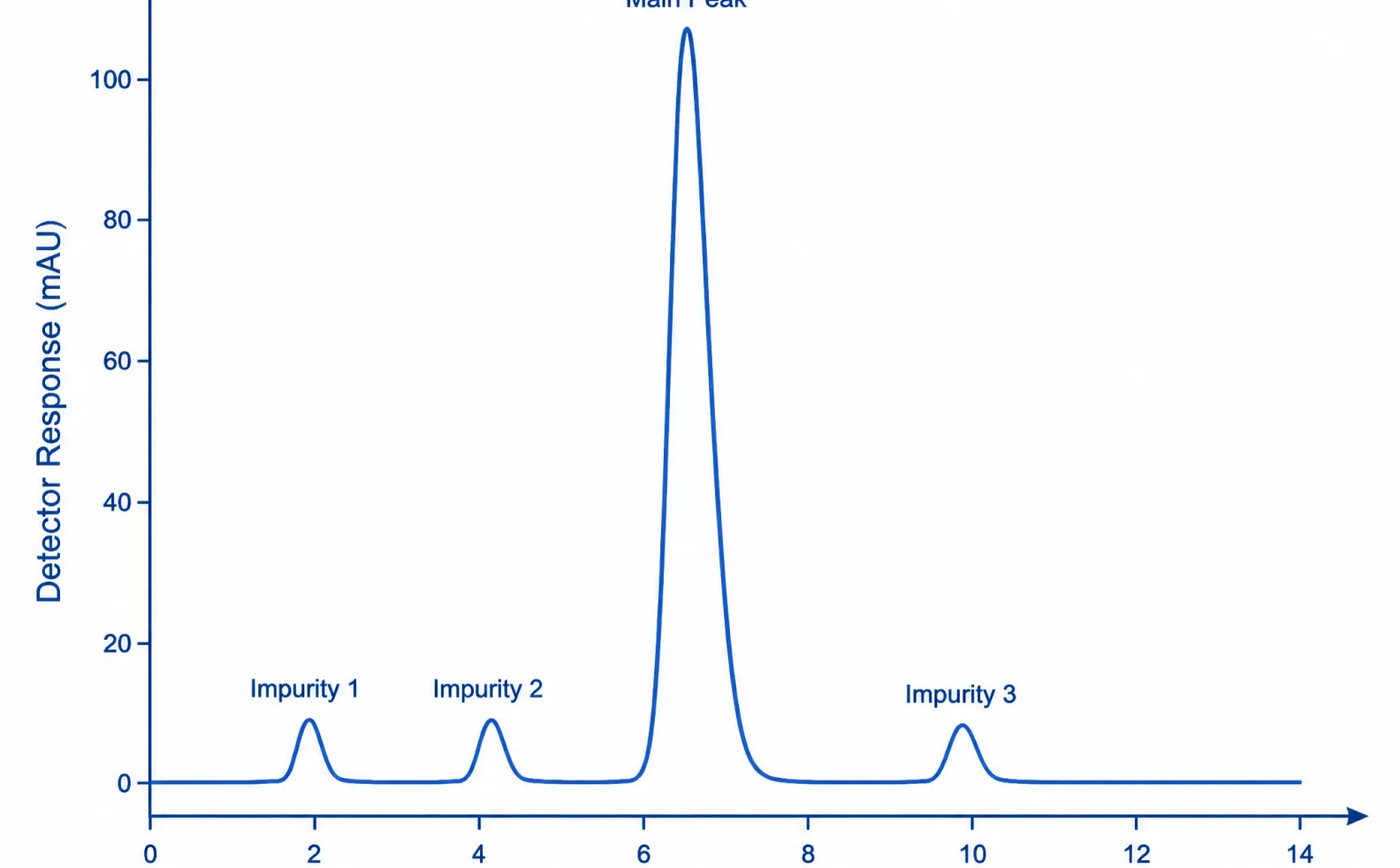
What regulators expect
Peptide impurity control now has its own regulatory shape. General frameworks such as ICH Q6A apply, and the EMA has issued a draft guideline on the development and manufacture of synthetic peptides that sets out impurity profiling and control expectations. In the United States, the FDA's 2021 guidance on abbreviated applications for highly purified synthetic peptides that reference recombinant originators is the key document. It names peptides including glucagon, liraglutide, nesiritide, teriparatide, and teduglutide, and asks developers to identify and justify each specified peptide-related impurity.
A large part of that justification is immunogenicity. Because an impurity with an added, deleted, or modified residue can introduce a new sequence not present in the active ingredient, it can create a new T-cell epitope and, in principle, an immune response. Regulators therefore expect developers to characterise these impurities and assess that risk, often with in silico and in vitro tools, and to keep the impurities under justified limits. This is provided as background on the regulatory landscape, not as regulatory or legal advice.
Where reference standards fit
Reference standards are what make peptide impurity control measurable. You need a well-characterised standard of the parent peptide to confirm identity and calibrate assays, and standards of the specified impurities to work with the related substances directly. Impurity standards let you locate a related-substance peak by HPLC spiking, quantify it against a known material, validate the method, and run system-suitability tests. For regulated work, each specified impurity generally needs its own characterised standard so its level can be measured and justified in the filing.
What reference standards do you need for peptide impurity control?
For a typical peptide, you need two things: a reference standard of the parent peptide, and standards of its named impurities. The parent standard anchors identity and calibration. The impurity standards, such as a specific deletion sequence, a diastereomer, an oxidised form, or a disulfide isomer, let you assign and quantify each related substance and support method validation and stability studies. Building this set early, before a pivotal batch, is what lets a team meet impurity and immunogenicity expectations without repeating work later.
How SynPeptide supports peptide impurity work
SynPeptide (Nanjing SynPeptide Biological Technology) has made peptides since 2013 and supplies reference-standard and related-substance peptides used in analytical development and quality control. For impurity work the useful points are:
- A line of drug peptide impurities and reference-standard peptides, including parent peptides and related substances for molecules such as salmon calcitonin, vasopressin analogues, lanreotide, atosiban, plecanatide, and teriparatide.
- Synthesis of specific named impurities to order, including deletion and truncated sequences, diastereomers, oxidised forms, and disulfide isomers, through custom peptide synthesis and peptide modification.
- Characterisation by HPLC and high-resolution mass spectrometry, with a certificate of analysis and identity data on every batch.
- A broader catalog of catalog peptides and active peptides that supports comparison, spiking, and method-development work.
These peptides are supplied as reference materials for research, analytical, and manufacturing use. They are not finished medicines and not for human use, and the regulatory responsibility for a drug product stays with the developer.
Talk to our peptide team
Need a parent reference standard or a specific named impurity for a method? Send us the sequence or structure, the impurity you need, and the purity and quantity, and we will come back with specifications and a quote. Reach the team at peptide@synpeptide.com.
FAQ
What are peptide impurities?
Peptide impurities are unwanted molecules that appear alongside the target peptide. They fall into two groups: process-related impurities made during synthesis, such as deletion, insertion, and diastereomer sequences, and degradation impurities formed later, such as deamidation, oxidation, and disulfide-scrambled forms. Because they are so close to the main peptide, they need dedicated methods to separate and measure.
Why do peptides need special impurity control?
The small-molecule limits in ICH Q3A do not transfer to peptides, whose impurities are large and structurally similar to the active ingredient and to each other. Control relies instead on peptide-specific analytical methods, characterised reference standards, and, for some impurities, an assessment of immunogenicity risk.
What is a peptide impurity reference standard?
It is a well-characterised sample of a specific impurity, such as a deletion sequence or an oxidised form, used to identify and quantify that impurity in a drug substance. Analysts spike it into a sample to locate the matching peak, measure the impurity against it, and use it in method validation and system-suitability testing.
Which peptides fall under the FDA synthetic-peptide guidance?
The FDA's 2021 guidance covers highly purified synthetic peptides submitted as generics of recombinant-origin products, and names glucagon, liraglutide, nesiritide, teriparatide, and teduglutide. For these, developers are expected to identify each specified peptide-related impurity and justify it, including its immunogenicity risk.
Can SynPeptide make a specific named impurity?
Yes. Alongside parent reference standards, we synthesise specific impurities to order, such as a defined deletion sequence, a diastereomer, an oxidised variant, or a disulfide isomer, and characterise them by HPLC and mass spectrometry with a certificate of analysis. Tell us the sequence and the impurity and we can scope it.
-

Synpeptide
peptide-focused CRO/CDMO company
The SynPeptide Research Team brings together scientists specializing in peptide synthesis, purification, and analytical characterization. Drawing on hands-on laboratory experience across custom and catalog peptides, the team shares evidence-based insights for researchers, formulators, and product developers. All content is reviewed against current scientific literature and internal quality-control data, reflecting SynPeptide's commitment to accuracy, reproducibility, and the responsible communication of peptide science.


