
Peptides are now one of the most-requested active categories in skincare, and the reason is simple: they act as targeted signals to skin cells at low use levels, rather than working by bulk chemistry. For a formulation or ingredient R&D team, choosing a peptide is only the first step. Whether it does anything in the finished product depends on picking the right functional class, getting it past the skin barrier, and keeping it stable in the base. This guide covers the peptide classes used in cosmetics, the formulation rules that decide performance, and what to check when sourcing peptide actives at scale.
The four functional classes of cosmetic peptides
Cosmetic peptides are usually grouped by how they act on the skin. Four classes cover most of what is on the market.
| Class | How it works | Representative INCI examples | Typical use |
| Signal peptides | Mimic matrikine fragments that prompt fibroblasts to make more collagen, elastin, and fibronectin | Palmitoyl Pentapeptide-4 (Matrixyl), Palmitoyl Tripeptide-1, Palmitoyl Tetrapeptide-7 | Firmness and fine-line support |
| Carrier peptides | Bind and deliver trace metals such as copper to support enzyme-linked processes | Copper Tripeptide-1 (GHK-Cu) | Conditioning and matrix support |
| Neurotransmitter-inhibiting peptides | Mimic the SNAP-25 sequence to dampen the nerve signal behind repeated muscle movement | Acetyl Hexapeptide-8 (Argireline), Acetyl Octapeptide-3 (SNAP-8), Pentapeptide-18 | Look of expression lines |
| Enzyme-inhibitor peptides | Slow the enzymes, such as MMPs, that break down existing collagen | Various tripeptides and tetrapeptides | Preserving the skin matrix |
A brand rarely relies on one class alone. Signal and neuromodulating peptides are often paired, since one supports structural proteins while the other works on the look of movement lines. Beyond the four classes, brightening peptides such as Nonapeptide-1 target pigment pathways, and conditioning peptides such as Hexapeptide-11 and lash-focused Myristoyl Pentapeptide-17 round out a modern range. A catalog that spans these functions lets a formulator design for firmness, expression lines, tone, and conditioning from one supplier.
Matching the class to the claim
The class tells you which part of skin biology an ingredient targets, which keeps a formula honest. A signal peptide supports collagen production. A neuromodulating peptide is studied for the appearance of expression lines. A carrier peptide delivers copper for enzyme-linked processes. Choosing the wrong class for a given claim wastes formula space and budget.
The penetration problem, and why so many peptides are lipidated
The biggest limit on any topical peptide is getting it into the skin. The stratum corneum is built to keep large, water-loving molecules out, and it excludes most hydrophilic molecules above roughly 500 Da. Many cosmetic peptides sit above that line and are hydrophilic, so the raw sequence on its own often does not penetrate well.
This is why so many INCI names start with "Palmitoyl" or "Myristoyl". Attaching a fatty acid to the peptide, through peptide modification, makes it more oil-loving, so it partitions into the stratum corneum instead of sitting on top. Pal-KTTKS and Palmitoyl Tripeptide-1 are the textbook cases. Where lipidation is not used, formulators turn to delivery systems such as liposomes, niosomes, or nanoemulsions that protect the peptide and carry it deeper. Both routes exist to solve the same barrier problem.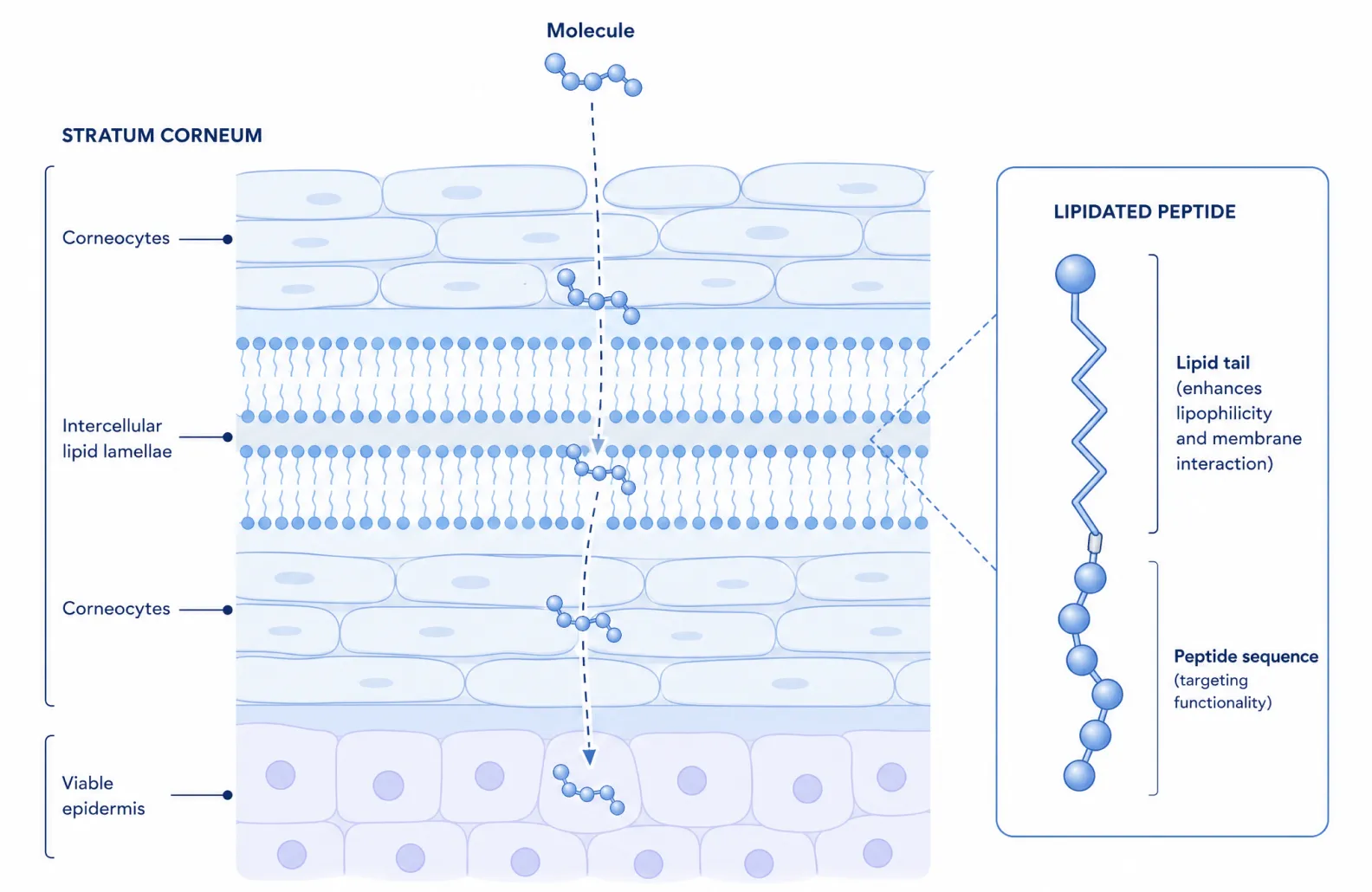
Formulating cosmetic peptides: the rules that decide performance
A peptide only performs if the formula respects its chemistry. A few rules apply across most cosmetic peptides:
- Hold pH around 5.0 to 7.0. Below about 4.5, acid-catalysed hydrolysis and deamidation degrade the peptide, so peptides and low-pH acid exfoliants belong in separate products. Copper peptides in particular lose activity below pH 5.0 as copper dissociates.
- Process cold. Add peptides at the cool-down stage, at or below 40 to 45 °C. High-shear mixing at high temperature will damage most peptide actives.
- Screen combinations. Peptides pair well with niacinamide, hyaluronic acid, and ceramides, and need care alongside strong acids, direct ascorbic acid, and chelating agents.
- Dose to the evidence. A peptide listed on the INCI at a fraction of its studied use level is label decoration and adds cost without function.
- Track stability by HPLC. Standard cosmetic stability testing does not follow peptide integrity on its own, so add HPLC checks across the intended shelf life.
Getting these right is the difference between a peptide that works and one that only appears on the label.
Sourcing cosmetic peptides at scale
For a brand moving from bench to production, the ingredient itself has to be reliable and reproducible. The main things to confirm with a supplier:
- Correct INCI identity and sequence, confirmed by mass spectrometry.
- Purity and a batch-specific certificate of analysis, backed by HPLC data.
- Consistent quality from lot to lot, so a formula behaves the same at every production run.
- Capacity and pricing that hold up at bulk scale, through large-scale peptide synthesis, without a jump in cost or a gap in supply.
Cosmetic manufacturers often care as much about steady capacity and cost as about the sequence, because a launched product needs continuous supply.
What makes a cosmetic peptide actually work in a product?
A cosmetic peptide works when three things line up: the right functional class for the intended benefit, a delivery approach that gets it past the skin barrier (usually lipidation or encapsulation), and a formula that holds it at a stable pH and is processed cold. Sequence and INCI name alone do not guarantee performance. A signal peptide at its studied use level in a well-built, pH 5.5 serum can support collagen; the same peptide underdosed in a low-pH base will not.
Why cosmetic brands source peptides from SynPeptide
SynPeptide (Nanjing SynPeptide Biological Technology) has made peptides since 2013 and supplies customers in more than one hundred countries, cosmetic and personal-care ingredient teams among them. For this market the useful points are:
- A catalog of cosmetic peptides across the main functions: signal peptides such as Palmitoyl Tetrapeptide-7, neuromodulating peptides such as Acetyl Octapeptide-3 (SNAP-8) and Pentapeptide-18, the brightening Nonapeptide-1, and conditioning peptides.
- Solid-phase synthesis across a 2 to 200 amino-acid range, so both short actives and longer sequences are in scope.
- Lipidation, acetylation, and other changes through peptide modification, including the palmitoyl and myristoyl conjugation that cosmetic peptides rely on for skin penetration.
- Large-scale peptide synthesis for raw-material supply, with the capacity and cost focus cosmetic production needs, plus custom peptide synthesis for novel or proprietary actives.
- Quality control by HPLC and mass spectrometry, with a certificate of analysis on every batch.
SynPeptide supplies these peptides as cosmetic ingredients to formulators and manufacturers. Product-level efficacy and marketing claims sit with the brand and must follow the cosmetic regulations of the market where the product is sold.
Talk to our peptide team
Sourcing a cosmetic peptide active, or developing a new one? Tell us the INCI name or sequence, the purity, and the scale you need, and we will send specifications, a sample where available, and a quote. Reach the team at peptide@synpeptide.com.
FAQ
What are peptides in cosmetics?
Cosmetic peptides are short chains of amino acids used as active ingredients in skincare. They work as signals to skin cells, and depending on the sequence they can support collagen production, deliver trace metals, soften the look of expression lines, or slow collagen breakdown. They are used as cosmetic ingredients, not as medicines.
What are the main types of cosmetic peptides?
The common framework has four classes: signal peptides that prompt collagen and elastin production, carrier peptides that deliver trace elements such as copper, neurotransmitter-inhibiting peptides that reduce the appearance of movement lines, and enzyme-inhibitor peptides that slow the enzymes breaking down the skin matrix. Many products combine more than one class.
Why are so many cosmetic peptides called "palmitoyl" or "acetyl"?
These prefixes mark a chemical change to the peptide. A palmitoyl or myristoyl group is a fatty acid attached to make the peptide more oil-soluble, so it can cross the skin barrier that blocks large water-loving molecules. An acetyl group caps the end of the peptide to improve stability. Both are standard ways to make a peptide usable in a topical product.
What pH and temperature do cosmetic peptides need?
Most cosmetic peptides are stable between pH 5.0 and 7.0 and should be added at the cool-down stage of a formulation, at or below about 45 °C. Below pH 4.5 they start to break down, which is why they are kept apart from low-pH acid exfoliants, and high-temperature, high-shear processing can damage them.
Are cosmetic peptides drugs?
No. Topical peptides used in skincare are regulated as cosmetic ingredients, not as drugs, and they are not intended to diagnose, treat, cure, or prevent any disease. What a brand may claim about a finished product depends on the cosmetic rules of the market where it is sold.
Can SynPeptide supply cosmetic peptides in bulk or make a custom one?
Yes. We supply catalog cosmetic peptides and can scale them for raw-material supply, and we make custom sequences and modified peptides to order. Each batch comes with HPLC and mass-spec data and a certificate of analysis, and we can advise on salt form, purity, and scale for a given formulation.
-

Synpeptide
peptide-focused CRO/CDMO company
The SynPeptide Research Team brings together scientists specializing in peptide synthesis, purification, and analytical characterization. Drawing on hands-on laboratory experience across custom and catalog peptides, the team shares evidence-based insights for researchers, formulators, and product developers. All content is reviewed against current scientific literature and internal quality-control data, reflecting SynPeptide's commitment to accuracy, reproducibility, and the responsible communication of peptide science.


