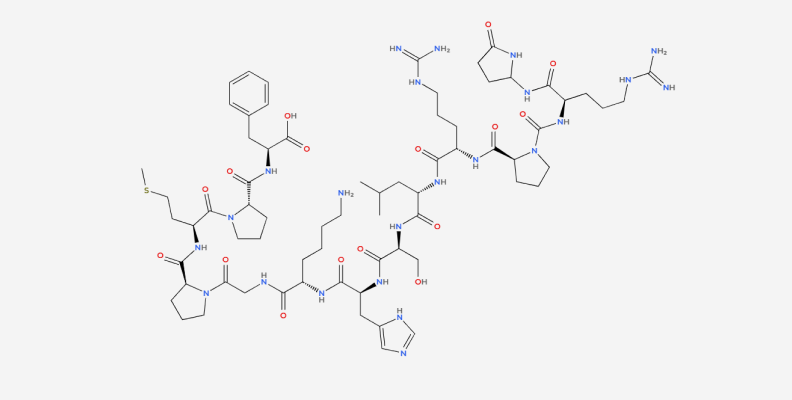
| Target Molecule | (Pyr1)-Apelin-13 (human, bovine) |
| Synonyms | (Glp1)-Apelin-13, [pGlu1]-Apelin-13, Pyroglutamyl apelin-13, Pyr-apelin-13 |
| CAS Number | 217082-60-5 (native uncyclized Apelin-13 is 217082-58-1) |
| Sequence (3-Letter) | pGlu-Arg-Pro-Arg-Leu-Ser-His-Lys-Gly-Pro-Met-Pro-Phe-OH |
| Sequence (1-Letter) | pGlu-RPRLSHKGPMPF |
| Molecular Formula | C₆₉H₁₀₈N₂₂O₁₆S |
| Molecular Weight | 1533.8 |
| Service Category | Custom Peptide Synthesis / CDMO Manufacturing |
| Synthesis Purity | Customizable (e.g., ≥95%, ≥98% via HPLC) |
| Appearance | White to off-white lyophilized powder |
| Counter Ion | Acetate, TFA, or custom salt options |
| Synthesis Technology | Solid-Phase Peptide Synthesis (SPPS) and Controlled N-Terminal Cyclization |
| Modification Options | N-terminal pyroglutamylation, stable isotope labeling (13C, 15N), fluorescent/biotin tagging, Met-oxidation standards |
| Available Scale | Milligram (R&D) to Kilogram (Commercial CDMO) |
| Analytical Data | Comprehensive COA, HPLC, MS, and cyclization verification provided per batch |
| Usage | Raw material synthesized strictly for laboratory research, analytical development, and industrial formulation. Not a finished medicine. |
(Pyr1)-Apelin-13 (CAS 217082-60-5) is a 13-residue regulatory peptide carrying an N-terminal pyroglutamate residue (pGlu-RPRLSHKGPMPF). We target this sequence to supply high-purity reference materials and raw materials for cardiovascular and metabolic receptor studies.
Converting the N-terminal glutamine into pyroglutamate requires controlled on-resin or post-cleavage cyclization conditions. Our peptide synthesis platform applies specialized activation chemistries to drive cyclization to completion, preventing uncyclized Gln1 intermediates and protecting the Met11 residue against premature oxidation.
Yes. We provide extensive peptide modification services for apelin research. Capabilities include the synthesis of uncyclized native Apelin-13 (CAS 217082-58-1) as a comparative reference standard, site-specific stable isotope labeling (13C, 15N) for LC-MS/MS, fluorescent tags, and intentionally oxidized methionine derivatives.
Our manufacturing infrastructure scales production from milligram-level analytical batches to multigram and kilogram commercial quantities. We optimize preparative HPLC purification and controlled counter-ion exchange (such as TFA removal to acetate) to ensure strict batch-to-batch consistency.
We operate as an integrated technical partner providing complete peptide CDMO solutions. Our team manages sequence optimization, impurity profiling, analytical method validation, and regulatory documentation to accelerate complex preclinical pipelines.
(Pyr1)-Apelin-13 (CAS 217082-60-5) is a biologically stabilized 13-amino acid peptide defined by the sequence pGlu-RPRLSHKGPMPF. Functioning as a high-affinity endogenous agonist at the apelin receptor (APJ), its N-terminal pyroglutamyl cap confers resistance against aminopeptidase degradation. Synpeptide provides comprehensive custom synthesis solutions for this molecule, showcasing our technical capabilities in post-translational modifications, impurity suppression, and CDMO manufacturing.
Constructing (Pyr1)-Apelin-13 requires high coupling efficiency across a sequence rich in proline and basic residues (Arg, Lys, His). Our custom peptide synthesis platform utilizes optimized Solid-Phase Peptide Synthesis (SPPS) protocols. By driving complete N-terminal cyclization and protecting the sensitive Met11 residue through inert atmosphere cleavage, we eliminate incomplete coupling intermediates, delivering raw materials with rigorous purity specifications (typically ≥95% or ≥98% via HPLC).
Accurate pharmacological profiling depends on distinguishing fully cyclized (Pyr1)-Apelin-13 from uncyclized Apelin-13 precursors. Through our peptide modification services, we synthesize the uncyclized form (CAS 217082-58-1) as an analytical comparator. We also incorporate heavy stable isotopes (13C, 15N) for quantitative mass spectrometry, attach fluorescent markers (FITC, Cy dyes) for receptor internalization assays, and synthesize methionine sulfoxide variants as stability-indicating impurity standards.
Moving post-translationally modified peptides from analytical batches to commercial supply demands reliable downstream purification. We execute large-scale peptide synthesis for (Pyr1)-Apelin-13 using high-capacity preparative HPLC systems and optimized lyophilization cycles. Our infrastructure accommodates requirements from milligram research batches to kilogram commercial lots, ensuring uniform counter-ion exchange (including acetate conversion) across all production volumes.
We deliver integrated technical support as a fully established peptide CDMO. Our development specialists assist pharmaceutical developers with analytical method validation, exact mass verification of the pyroglutamate cap, and long-term stability assessments. Every batch is released with complete documentation—including COA, HPLC purity traces, and high-resolution MS data—ensuring regulatory alignment for downstream therapeutic programs.


