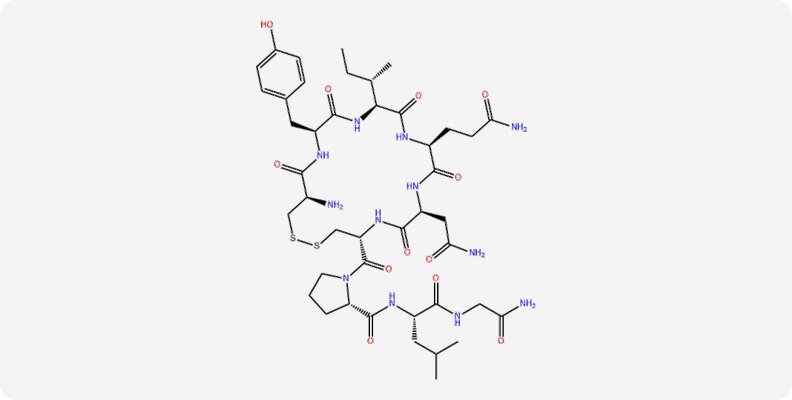
| Target Molecule | Oxytocin Acetate |
| Synonyms | Oxytocin, Pitocin, Syntocinon, α-Hypophamine |
| CAS Number | 50-56-6 (free base); 6233-83-6 (acetate salt) |
| Sequence (3-Letter) | H-Cys-Tyr-Ile-Gln-Asn-Cys-Pro-Leu-Gly-NH₂ (cyclic Cys1–Cys6 disulfide) |
| Sequence (1-Letter) | CYIQNCPLG-NH₂ |
| Molecular Formula | C₄₃H₆₆N₁₂O₁₂S₂ (free base) |
| Molecular Weight | 1007.19 (free base) |
| Service Category | Custom Peptide Synthesis / CDMO Manufacturing |
| Synthesis Purity | Customizable (e.g., ≥98%, ≥99% via HPLC) |
| Appearance | White to off-white lyophilized powder |
| Counter Ion | Acetate (standard pharmaceutical salt), TFA, or custom salt options |
| Synthesis Technology | Solid-Phase Peptide Synthesis (SPPS) and Directed Oxidative Folding |
| Modification Options | Intramolecular disulfide bridging, stable isotope labeling (13C, 15N), structural analogue synthesis (Carbetocin, Demoxytocin), linear precursor standards |
| Available Scale | Milligram (R&D) to Kilogram (Commercial CDMO) |
| Analytical Data | Comprehensive COA, HPLC, MS, and disulfide connectivity verification provided per batch |
| Usage | Raw material synthesized strictly for laboratory research, analytical development, and industrial formulation. Not a finished medicine. |
Oxytocin Acetate (CAS 50-56-6 free base, CAS 6233-83-6 acetate) is a synthetic cyclic nonapeptide hormone featuring a crucial Cys1–Cys6 intramolecular disulfide bridge and C-terminal amidation (CYIQNCPLG-NH₂). We target this sequence to supply high-purity reference materials and raw materials for reproductive biology, neuroscience, and obstetric research.
Assembling Oxytocin requires high-fidelity sequence elongation followed by meticulous intramolecular cyclization between Cys1 and Cys6. Our peptide synthesis platform utilizes optimized Solid-Phase Peptide Synthesis (SPPS) protocols on low-loading resins and directed oxidative folding techniques, suppressing intermolecular oligomerization and delivering pure monomeric products.
Yes. We provide specialized peptide modification services for oxytocin-family peptides. Options include site-specific stable isotope labeling (13C, 15N) for quantitative mass spectrometry (LC-MS/MS), fluorescent or biotin tagging, and the deliberate synthesis of uncyclized linear precursors and scrambled isomers as critical analytical standards.
Our manufacturing infrastructure scales production from milligram-level analytical batches to multigram and kilogram commercial quantities. We optimize preparative HPLC purification and controlled counter-ion exchange (ensuring acetate salt conversion) to guarantee strict batch-to-batch consistency.
We operate as an integrated technical partner providing complete peptide CDMO solutions. Our team manages sequence optimization, disulfide verification, impurity profiling, analytical method validation, and regulatory documentation to accelerate complex drug development pipelines.
Oxytocin Acetate (CAS 50-56-6 free base, 6233-83-6 acetate), historically commercialized under brand names such as Pitocin and Syntocinon, is a cyclic nonapeptide hormone defined by the sequence H-Cys-Tyr-Ile-Gln-Asn-Cys-Pro-Leu-Gly-NH₂ with a Cys1–Cys6 disulfide bridge. Acting as a potent oxytocin receptor (OXTR) agonist, it plays pivotal roles in uterine contractility, lactation, and social cognition circuits. Synpeptide provides comprehensive custom synthesis solutions for this molecule, demonstrating our advanced technical capabilities in controlled oxidative folding, disulfide constraint, and CDMO manufacturing.
Constructing the 9-residue cyclic sequence requires high-fidelity solid-phase elongation followed by precise intramolecular ring closure between Cys1 and Cys6. Uncontrolled oxidation can lead to inactive linear forms or intermolecular oligomeric aggregates. Our custom peptide synthesis platform utilizes optimized Solid-Phase Peptide Synthesis (SPPS) protocols, sequence-specific resin selection, and directed oxidative folding techniques to ensure exact stereochemical fidelity and high-yield ring closure with rigorous purity specifications (typically ≥98% via HPLC).
Oxytocin shares high sequence homology with vasopressin (differing only at positions 3 and 8) and serves as the structural parent for critical therapeutic analogues like Carbetocin. Through our peptide modification services, we synthesize related analogues, provide stable isotope labeling (13C, 15N) for pharmacokinetic bioanalysis, and construct specific uncyclized linear precursors or degradation variants as vital reference standards for stability-indicating analytical assays.
Transitioning a cyclic nonapeptide from laboratory screening to commercial production requires robust downstream chemical engineering. The high-dilution conditions required to prevent intermolecular oligomerization during cyclization demand specialized process design. We execute large-scale peptide synthesis for Oxytocin Acetate utilizing continuous-flow oxidation systems and high-capacity preparative HPLC purification, scaling seamlessly from milligram research batches to kilogram commercial lots with verified batch-to-batch consistency and precise acetate counter-ion control.
We deliver comprehensive technical support as a fully integrated peptide CDMO. Our development specialists assist pharmaceutical partners with process optimization, stability testing, impurity identification, and analytical method validation. Every batch is released with complete documentation—including COA, HPLC purity traces, and exact mass confirmation—ensuring regulatory alignment for downstream clinical-stage programs.


