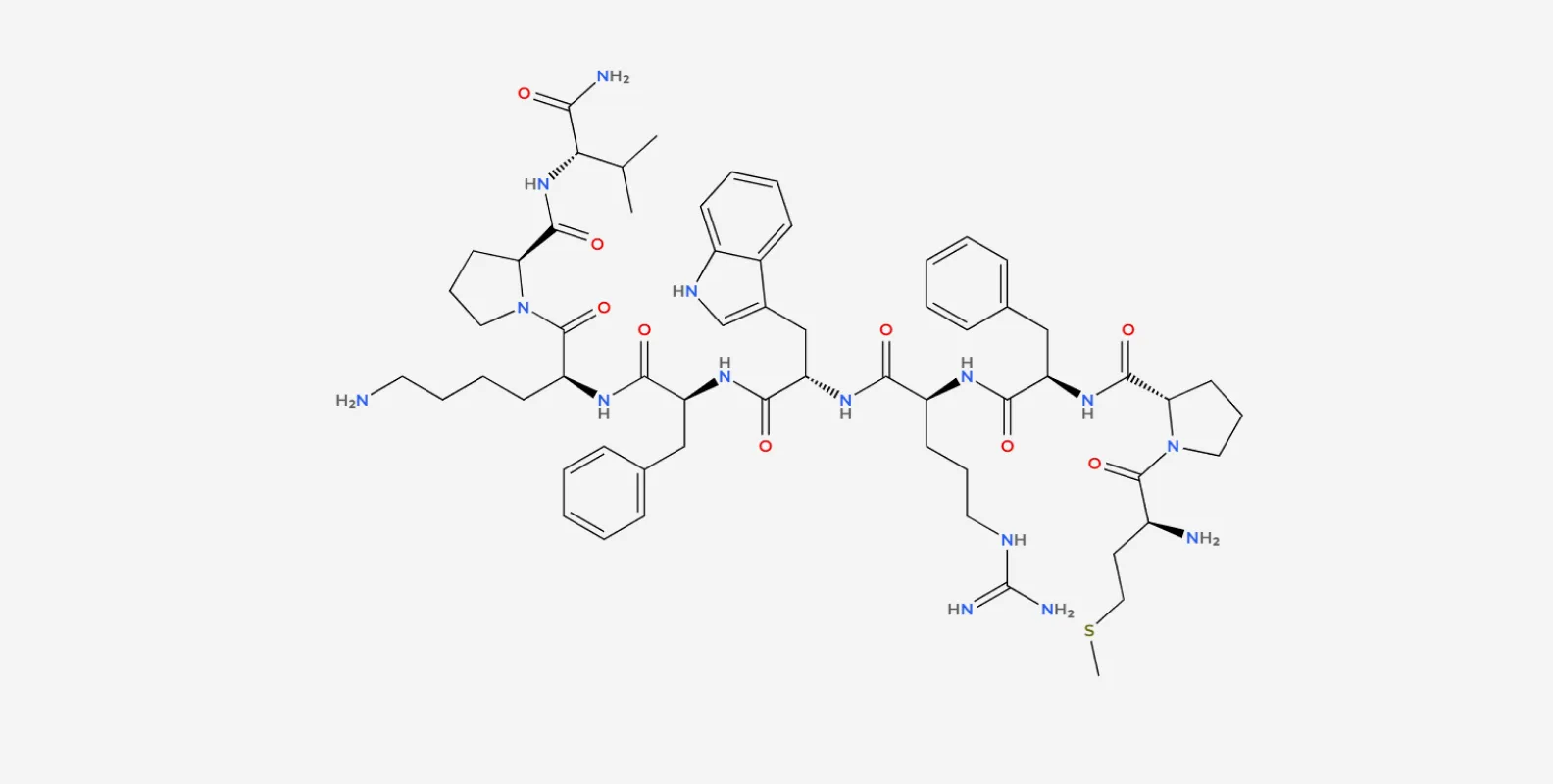
| Target Molecule | Nonapeptide-1 (Melanostatine-5) |
| Synonyms | Melanostatine-5, Melanostatine, Met-Pro-D-Phe-Arg-D-Trp-Phe-Lys-Pro-Val-NH₂ |
| CAS Number | 158563-45-2 |
| Sequence (3-Letter) | Met-Pro-D-Phe-Arg-D-Trp-Phe-Lys-Pro-Val-NH₂ |
| Sequence (1-Letter) | MPfRwFKPV-NH₂ (f = D-Phe, w = D-Trp) |
| Molecular Formula | C₆₁H₈₇N₁₅O₉S |
| Molecular Weight | 1206.52 |
| Service Category | Custom Synthesis / Cosmetic Peptide R&D |
| Synthesis Purity | Customizable (e.g., ≥95%, ≥98%, ≥99% by HPLC) |
| Appearance | White to off-white powder |
| Counter Ion | Acetate (TFA-free available) or Custom Options |
| Synthesis Technology | Solid-Phase Peptide Synthesis (SPPS) |
| Modification Options | Isotopic labeling, specific counter-ions, alternate terminal modifications |
| Available Scale | Milligram (R&D) to Kilogram (Commercial Manufacturing) |
| Analytical Data | Comprehensive COA, HPLC, MS provided per batch |
| Usage | Raw material synthesized strictly for laboratory research, cosmetic formulation R&D, and industrial manufacturing. Not a finished drug. |
Nonapeptide-1 (CAS 158563-45-2) is a synthetic nine-amino-acid biomimetic peptide featuring a C-terminal amide and specific D-amino acid substitutions (D-phenylalanine and D-tryptophan). We synthesize this specific sequence as a high-purity raw material for structural research and cosmetic formulation development.
We utilize optimized solid-phase peptide synthesis (SPPS). This platform ensures highly efficient amino acid coupling—specifically managing the steric requirements of the integrated D-amino acids—and precise control over deletion impurities, yielding batches that meet strict HPLC purity specifications.
Yes. While the standard sequence acts as an alpha-MSH antagonist in research models, our modification services can add targeted N-terminal protecting groups, specific counter-ions, or isotopic labels to suit specific physical chemistry requirements for advanced R&D.
Our infrastructure transitions seamlessly from milligram-scale laboratory batches to kilogram-scale commercial production. We maintain rigorous batch-to-batch consistency essential for industrial-scale cosmetic formulation.
We serve as a strategic technical partner. Our team assists with sequence stability testing, impurity profiling, and the provision of complete analytical documentation to accelerate downstream formulation projects.
Nonapeptide-1, defined by the sequence MPfRwFKPV-NH2 and referenced as Melanostatine-5, is a synthetic biomimetic peptide modeled on an alpha-MSH fragment. Synpeptide provides comprehensive synthetic solutions for this target molecule, leveraging our technical expertise to support industrial formulation development and dermatological R&D.
Through our established peptide synthesis platform, we achieve efficient coupling of the nonamer sequence via optimized Solid-Phase Peptide Synthesis (SPPS). We strictly control impurity profiles during the integration of stability-enhancing D-amino acids (D-Phe and D-Trp), ensuring the final Nonapeptide-1 material meets exact purity specifications (routinely ≥98% via HPLC). This rigorous process control guarantees the batch-to-batch reproducibility required for both early-stage research and late-stage commercial formulation.
The standard structure of Nonapeptide-1 requires C-terminal amidation. Beyond this baseline, we offer extensive peptide modification services. Formulators can request specific counter-ion exchanges (such as TFA to acetate conversions), targeted N-terminal modifications for altered solubility, or isotopic labeling for tracking studies. These structural adjustments enable researchers to precisely tune the molecule's physical properties for advanced delivery systems.
Scaling a peptide from benchtop research to commercial application demands stable manufacturing protocols. We facilitate efficient large-scale peptide synthesis for Nonapeptide-1, managing the transition from milligram screening batches to kilogram-scale production. Our large-scale infrastructure ensures a continuous, reliable supply chain for global cosmetic manufacturers, supported by complete analytical documentation including COA, MS, and HPLC data for every delivered batch.
We function as a technical extension of our clients' teams, providing one-stop peptide formulation support. Our engineers assist clients in stability testing, degradation profiling, and identifying optimal handling conditions for Nonapeptide-1 in various matrices. By delivering precise analytical data alongside high-purity synthetic capacity, we enable R&D teams to execute complex formulation projects efficiently and confidently.


