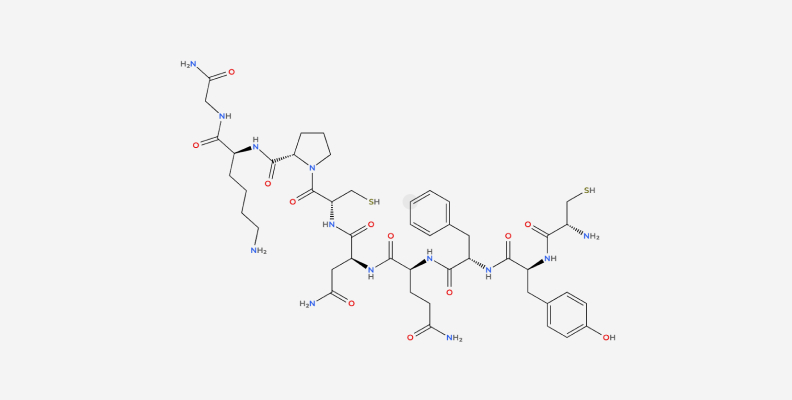
| Target Molecule | Lypressin (Lysine Vasopressin) |
| Synonyms | [Lys8]-Vasopressin; Lysipressin; LVP; 8-L-lysine vasopressin |
| CAS Number | 50-57-7 |
| Sequence (3-Letter) | H-Cys-Tyr-Phe-Gln-Asn-Cys-Pro-Lys-Gly-NH2 |
| Sequence (1-Letter) | CYFQNCPKG-NH2 (9 residues; C-terminal amide) |
| Disulfide Bridge | Cys1–Cys6 (intramolecular) |
| Molecular Formula | C₄₆H₆₅N₁₃O₁₂S₂ |
| Molecular Weight | 1056.2 |
| Service Category | Custom Synthesis / Pharmaceutical Peptide Reference Standards |
| Synthesis Purity | Customizable (e.g., ≥95%, ≥98%, ≥99% by HPLC) |
| Appearance | White to off-white lyophilized powder |
| Counter Ion | Acetate or Custom Options |
| Synthesis Technology | Solid-Phase Peptide Synthesis (SPPS) with Controlled Oxidation |
| Modification Options | Isotopic labeling, disulfide-isomer generation, sequence truncations |
| Available Scale | Milligram (Analytical Reference) to Kilogram (Commercial Manufacturing) |
| Analytical Data | Comprehensive COA, HPLC, MS identity; extended characterization on request |
| Usage | Raw material synthesized strictly for laboratory research, pharmaceutical R&D, and quality control. Not a finished drug. |
Lypressin (CAS 50-57-7) is a 9-amino-acid synthetic peptide featuring a C-terminal amide and an intramolecular disulfide bridge connecting Cys1 and Cys6. We synthesize this specific structure as a high-purity raw material for analytical reference and pharmaceutical development.
We utilize optimized solid-phase peptide synthesis (SPPS) followed by strict controlled oxidation. This platform ensures highly efficient amino acid coupling and exact disulfide pairing, yielding batches that meet rigorous HPLC purity specifications.
Yes. Our modification services can generate specific related substances, including disulfide-bond isomers, reduced open-chain forms, deamidation products, acetylated and truncated sequences, dimers, and targeted isotopic labels, to support your analytical method development and quality control.
Our infrastructure transitions seamlessly from milligram-scale reference standard batches to kilogram-scale commercial production. We maintain rigorous batch-to-batch consistency essential for industrial-scale pharmaceutical formulation.
We serve as a strategic technical partner. Our team assists with stability testing, comprehensive impurity profiling, and the provision of complete analytical documentation to accelerate downstream regulatory and formulation projects.
Lypressin, defined by the sequence CYFQNCPKG-NH2 and featuring a Cys1-Cys6 intramolecular disulfide bridge, is a synthetic vasopressin analogue utilized in pharmaceutical research and development. Synpeptide provides comprehensive synthetic solutions for this target molecule, leveraging our technical expertise to support industrial formulation development and analytical control.
Through our established peptide synthesis platform, we achieve efficient coupling of the 9-residue sequence via optimized Solid-Phase Peptide Synthesis (SPPS). We execute precise, controlled oxidation to form the essential Cys1–Cys6 disulfide bridge, strictly controlling impurity profiles during manufacturing. This ensures the final material meets exact purity specifications (routinely ≥98% via HPLC). This rigorous process control guarantees the reproducibility required for advanced analytical research and commercial applications.
A central analytical challenge for Lypressin is confirming the correct disulfide pairing and monitoring degradation. Beyond synthesizing the parent active pharmaceutical ingredient, we offer extensive peptide modification services. Researchers can request the targeted synthesis of specific related substances—such as disulfide-bond isomers, reduced open-chain forms, deamidation products, or truncated species—for use as analytical reference standards. We also provide isotopic labeling for tracking studies, enabling precise method development and validation.
Scaling a disulfide-bridged peptide from benchtop research to commercial application demands highly stable manufacturing protocols. We facilitate efficient large-scale peptide synthesis for Lypressin, managing the transition from milligram analytical batches to kilogram-scale production. Our large-scale infrastructure ensures a continuous, reliable supply chain for pharmaceutical developers, supported by complete analytical documentation including COA, MS, and HPLC data.
We function as a technical extension of our clients' teams, providing one-stop drug peptide impurity and formulation support. Our engineers actively assist clients in sequence stability assessments, impurity profiling, and degradation analysis under various storage conditions. By delivering precise analytical data alongside high-purity synthetic capacity, we enable R&D teams to execute complex analytical control and pharmaceutical development projects efficiently.


