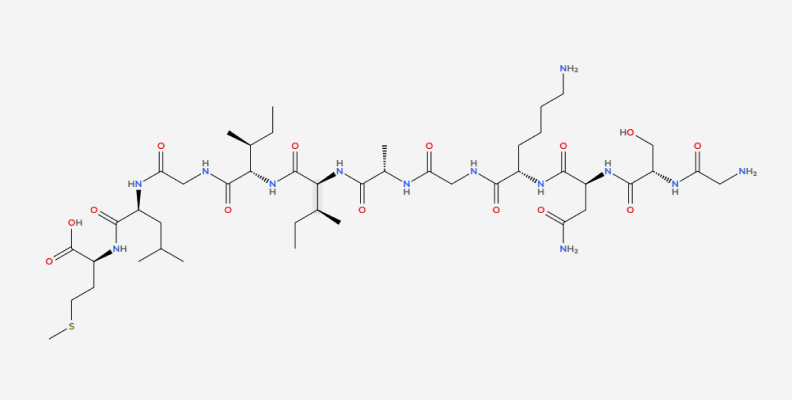
| Target Molecule | Amyloid β-Protein (25-35) |
| Synonyms | β-Amyloid (25-35); Amyloid beta-peptide (25-35); Aβ (25-35); beta-Amyloid (25-35) |
| CAS Number | 131602-53-4 |
| Sequence (3-Letter) | H-Gly-Ser-Asn-Lys-Gly-Ala-Ile-Ile-Gly-Leu-Met-OH |
| Sequence (1-Letter) | GSNKGAIIGLM |
| Molecular Formula | C₄₅H₈₁N₁₃O₁₄S |
| Molecular Weight | 1060.3 |
| Service Category | Custom Peptide Synthesis / CDMO Manufacturing |
| Synthesis Purity | Customizable (e.g., ≥95%, ≥98% via HPLC) |
| Appearance | White to off-white lyophilized powder |
| Counter Ion | Trifluoroacetate (TFA), acetate, or custom salt options |
| Synthesis Technology | Solid-Phase Peptide Synthesis (SPPS) for aggregation-prone sequences |
| Modification Options | Scrambled controls, C-terminal amidation, fluorescent/biotin labeling, stable isotopes |
| Available Scale | Milligram (R&D) to Kilogram (Commercial CDMO) |
| Analytical Data | COA, HPLC, MS, and extended regulatory documentation provided per batch |
| Usage | Raw material synthesized strictly for laboratory research, analytical development, and industrial formulation. Not a finished medicine. |
Amyloid Beta (25-35) (CAS 131602-53-4) is an 11-residue peptide (GSNKGAIIGLM) corresponding to the core self-assembling and neurotoxic domain of full-length amyloid-beta[cite: 6]. We target this sequence to supply high-purity reference materials and raw materials for Alzheimer's disease and neurodegenerative research.
Aβ (25-35) is prone to rapid beta-sheet aggregation during solid-phase peptide synthesis (SPPS)[cite: 6]. Our peptide synthesis platform prevents premature on-resin aggregation and coupling failure through optimized pseudoproline dipeptides, chaotropic cleavage reagents, and inert gas handling to protect the C-terminal methionine from oxidation[cite: 6].
Yes. We provide specialized peptide modification services for amyloid sequences. Options include scrambled sequence controls for assay validation, C-terminal amidation, site-specific fluorescent or biotin labeling, and stable isotope incorporation (13C, 15N) for quantitative mass spectrometry.
Our manufacturing infrastructure scales production from milligram research batches to kilogram commercial supply. We utilize specialized preparative HPLC purification and controlled counter-ion exchange (such as TFA removal to acetate) to ensure defined aggregation kinetics and batch-to-batch consistency.
We operate as a technical partner providing complete peptide CDMO solutions. Our team manages sequence optimization, impurity profiling, aggregation kinetics characterization, and regulatory documentation to advance neurobiology research and drug development.
Amyloid β-Protein (25-35), defined by the 11-residue sequence GSNKGAIIGLM, contains the core self-assembling and neurotoxic sequence of full-length amyloid-beta[cite: 6]. Synpeptide provides comprehensive synthetic solutions for this target molecule. Overcoming the pronounced aggregation and insolubility of this sequence demonstrates our advanced technical capabilities in difficult peptide synthesis and CDMO manufacturing[cite: 6].
The hydrophobic nature and spontaneous beta-sheet fibrillization of Aβ (25-35) present severe risks of chain aggregation and incomplete coupling during elongation[cite: 6]. Our custom peptide synthesis platform resolves these hurdles using optimized solid-phase peptide synthesis (SPPS) protocols, chaotropic solvating reagents, and efficient coupling chemistries[cite: 6]. This ensures complete coupling at each cycle and suppresses deletion sequences, delivering high-purity monomeric peptide (typically ≥95% or ≥98% via HPLC) for reliable biological screening[cite: 6].
Neurodegenerative disease research requires precisely engineered controls to distinguish specific bioactivity from non-specific aggregation artifacts. Through our peptide modification services, we routinely synthesize scrambled sequence controls, C-terminally amidated variants, and fluorescently tagged derivatives (such as FITC or Cy dyes) for monitoring fibril formation[cite: 6]. We also control the oxidation state of the terminal methionine residue and incorporate stable isotopes (13C, 15N) for absolute quantification in mass spectrometry[cite: 6].
Scaling aggregation-prone hydrophobic peptides requires specialized process engineering during chromatographic isolation and lyophilization. Residual trifluoroacetate (TFA) can compromise cell viability in sensitive neuronal cultures[cite: 6]. Through our large-scale peptide synthesis infrastructure, we manage multigram to kilogram production with validated TFA-removal and acetate conversion protocols[cite: 6]. High-resolution preparative HPLC ensures consistent monomeric fractions and reproducible solubility across production batches.
We deliver integrated technical support as an established peptide CDMO. Our development teams assist researchers and pharmaceutical developers with aggregation profiling, analytical method validation, and complete physicochemical release testing. Each batch is supported by comprehensive analytical documentation (including COA, HPLC chromatograms, and MS identity confirmation) to ensure compliance and reproducibility in downstream neurodegenerative drug development[cite: 6].


