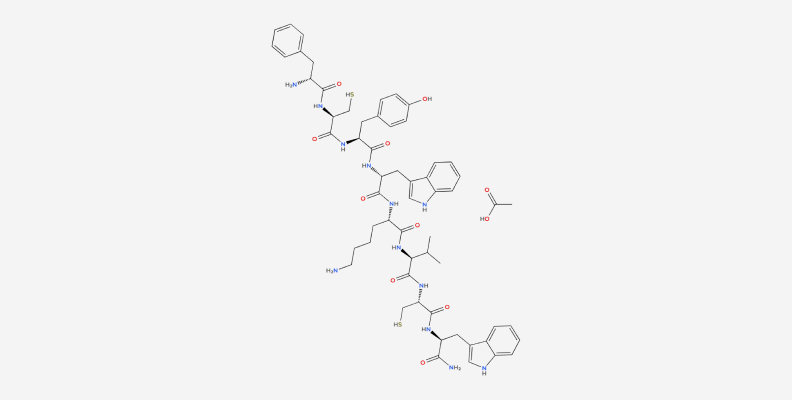
| Target Molecule | Vapreotide Acetate |
| Synonyms | Vapreotide, RC-160, Sanvar, Octastatin, BMY-41606 |
| CAS Number | 103222-11-3 (free base); 849479-74-9 (acetate salt) |
| Sequence (3-Letter) | H-D-Phe-Cys-Tyr-D-Trp-Lys-Val-Cys-Trp-NH₂ (cyclic Cys2–Cys7 disulfide) |
| Sequence (1-Letter) | FCYWKVCW-NH₂ (D-Phe1, D-Trp4; disulfide Cys2–Cys7) |
| Molecular Formula | C₅₇H₇₀N₁₂O₉S₂ (free base) |
| Molecular Weight | 1131.4 (free base) |
| Service Category | Custom Peptide Synthesis / CDMO Manufacturing |
| Synthesis Purity | Customizable (e.g., ≥95%, ≥98% via HPLC) |
| Appearance | White to off-white lyophilized powder |
| Counter Ion | Acetate (standard pharmaceutical salt), TFA, or custom options |
| Synthesis Technology | Solid-Phase Peptide Synthesis (SPPS) and Regioselective Disulfide Cyclization |
| Modification Options | Intramolecular disulfide bridging, D-amino acid incorporation, stable isotope labeling, C-terminal amidation |
| Available Scale | Milligram (R&D) to Kilogram (Commercial CDMO) |
| Analytical Data | Comprehensive COA, HPLC, MS, and disulfide connectivity verification provided per batch |
| Usage | Raw material synthesized strictly for laboratory research, analytical development, and industrial formulation. Not a finished medicine. |
Vapreotide Acetate (CAS 103222-11-3) is a cyclic octapeptide somatostatin analog containing D-Phe1, D-Trp4, a Cys2-Cys7 disulfide bridge, and a C-terminal amide. We target this sequence to supply high-purity reference materials and raw materials for oncology and endocrinology research.
The sequence incorporates D-Phe and D-Trp to improve metabolic stability against proteases. Incorporating unnatural D-enantiomers alters coupling kinetics and introduces epimerization risks. Our peptide synthesis platform applies specialized coupling reagents and mild reaction conditions to guarantee stereochemical integrity and high crude purity.
Forming the compact Cys2-Cys7 intramolecular disulfide ring requires controlled oxidation conditions to prevent multimeric aggregation. Our peptide modification services apply dilute-solution oxidation and directed cyclization protocols, validating disulfide connectivity and monomeric fidelity through high-resolution LC-MS/MS and peptide mapping.
Transitioning cyclic peptides from exploratory scale to commercial volumes requires robust chemical engineering. Our manufacturing infrastructure optimizes liquid-phase handling, high-capacity preparative HPLC purification, and counter-ion conversion to ensure consistent acetate salt profiles from milligrams to kilograms.
We operate as an integrated technical partner providing complete peptide CDMO solutions. Our team manages sequence optimization, cyclization verification, impurity profiling, analytical method validation, and regulatory documentation to support complex therapeutic pipelines.
Vapreotide Acetate, frequently referenced as RC-160 or Sanvar, is an 8-residue cyclic somatostatin analog (FCYWKVCW-NH2). Rather than supplying this solely as a catalog reagent, we utilize this highly engineered sequence as a benchmark to demonstrate our advanced manufacturing capabilities. Its construction requires the management of D-amino acids, C-terminal amidation, and intramolecular disulfide ring closure, making it an ideal model for our comprehensive peptide synthesis and CDMO services.
The Vapreotide sequence incorporates two D-amino acids (D-Phe1 and D-Trp4) to enhance its in vivo stability against peptidases. During solid-phase peptide synthesis (SPPS), these unnatural chiral centers present specific challenges, notably the risk of epimerization and reduced coupling efficiency due to steric hindrance. We overcome these inherent synthetic hurdles through our custom peptide synthesis platform. By utilizing highly optimized coupling cocktails and precise reaction monitoring, we ensure exact stereochemical fidelity and high-yield chain elongation.
The defining structural feature of Vapreotide is the essential disulfide bond bridging Cys2 and Cys7, which locks the peptide into its biologically active conformation. Uncontrolled oxidation can lead to inactive linear forms, scrambled isomers, or polymeric aggregates. Our peptide modification services encompass advanced oxidative folding protocols, utilizing directed cystine-protecting groups or optimized liquid-phase thermodynamic folding. The exact disulfide connectivity and the absence of polymeric impurities are strictly validated using high-resolution analytical techniques.
Moving a highly constrained cyclic octapeptide from laboratory synthesis to commercial viability presents significant chemical engineering hurdles. The high-dilution conditions typically required for intramolecular cyclization often create bottlenecks during scale-up. Our large-scale peptide synthesis infrastructure manages this transition via specialized continuous-flow oxidation systems and customized gradient preparative HPLC purification. We routinely scale the production of cyclic somatostatin analogs from milligram research quantities to kilogram batches. Integrated within our full peptide CDMO services, we supply these materials with comprehensive analytical method validation, detailed impurity profiling, and robust batch-to-batch consistency for licensed pharmaceutical developers.
We deliver comprehensive technical support as a fully established peptide CDMO partner. Our technical teams assist clients through sequence optimization, process qualification, and the preparation of stability-indicating analytical documentation. Whether generating isotope-labeled internal standards or scaling up GMP-grade clinical batches, our engineering teams provide the regulatory documentation and batch reproducibility required to accelerate drug development pipelines.


