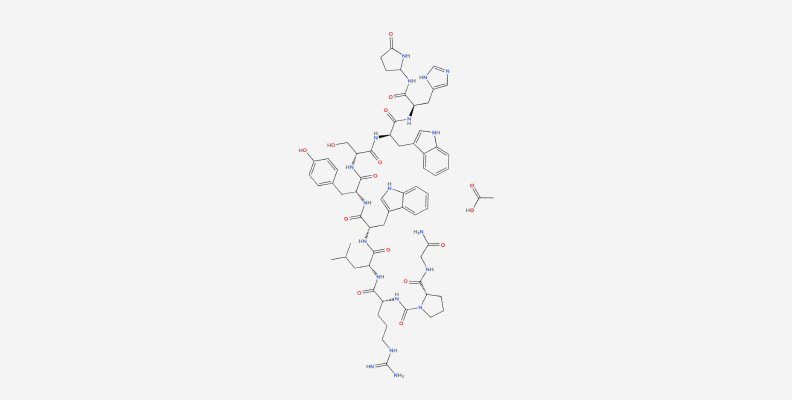
| Target Molecule | Triptorelin Acetate |
| Synonyms | Triptorelin, Decapeptyl, Diphereline, Trelstar, [D-Trp6]-LHRH |
| CAS Number | 140194-24-7 (acetate salt); 57773-63-4 (free base) |
| Sequence (3-Letter) | pGlu-His-Trp-Ser-Tyr-D-Trp-Leu-Arg-Pro-Gly-NH₂ |
| Sequence (1-Letter) | pGlu-HWSYwLRPG-NH₂ |
| Molecular Formula | C₆₄H₈₂N₁₈O₁₃ (free base) |
| Molecular Weight | 1311.45 (free base) |
| Service Category | Custom Peptide Synthesis / CDMO Manufacturing |
| Synthesis Purity | Customizable (e.g., ≥95%, ≥98% via HPLC) |
| Appearance | White to off-white lyophilized powder |
| Counter Ion | Acetate (standard pharmaceutical salt), TFA, or custom options |
| Synthesis Technology | Solid-Phase Peptide Synthesis (SPPS) for Modified Decapeptides |
| Modification Options | D-tryptophan substitution at position 6, N-terminal pyroglutamylation, C-terminal amidation, stable isotope labeling (13C, 15N), diastereomer impurity standards |
| Available Scale | Milligram (R&D) to Kilogram (Commercial CDMO) |
| Analytical Data | Comprehensive COA, HPLC, MS, and chiral purity confirmation provided per batch |
| Usage | Raw material synthesized strictly for laboratory research, analytical development, and industrial formulation. Not a finished medicine. |
Triptorelin Acetate (CAS 140194-24-7) is a synthetic decapeptide gonadotropin-releasing hormone (GnRH) receptor agonist featuring N-terminal pyroglutamylation, a D-tryptophan substitution at position 6, and C-terminal amidation (pGlu-His-Trp-Ser-Tyr-D-Trp-Leu-Arg-Pro-Gly-NH₂). We target this sequence to supply high-purity reference materials and raw materials for oncology, reproductive endocrinology, and prostate cancer research.
Incorporating a bulky D-tryptophan residue at position 6 increases steric hindrance during chain elongation, raising the risk of epimerization. Our peptide synthesis platform utilizes optimized Solid-Phase Peptide Synthesis (SPPS) protocols, high-efficiency coupling reagents, and rigorous temperature control to ensure high-fidelity assembly without chiral inversion.
Yes. We provide specialized peptide modification services for GnRH analogues. Options include the synthesis of specific diastereomeric impurities as critical reference standards for stability-indicating assays, site-specific stable isotope labeling (13C, 15N) for quantitative mass spectrometry (LC-MS/MS), and fluorescent or biotin tagging.
Our manufacturing infrastructure scales production from milligram-level analytical batches to multigram and kilogram commercial quantities. We optimize preparative HPLC purification and controlled counter-ion exchange (ensuring acetate salt conversion) to guarantee strict batch-to-batch consistency.
We operate as an integrated technical partner providing complete peptide CDMO solutions. Our team manages sequence optimization, impurity profiling, analytical method validation, and regulatory documentation to support complex drug development pipelines.
Triptorelin Acetate (CAS 140194-24-7), commercialized under brand names such as Decapeptyl, Diphereline, and Trelstar, is a synthetic decapeptide functioning as a potent gonadotropin-releasing hormone (GnRH) receptor agonist. Defined by the sequence pGlu-His-Trp-Ser-Tyr-D-Trp-Leu-Arg-Pro-Gly-NH₂, it substitutes native glycine at position 6 with D-tryptophan, significantly enhancing metabolic resistance and receptor binding affinity. Synpeptide delivers comprehensive custom synthesis solutions for this target molecule, demonstrating our technical expertise in non-standard amino acid assembly, stereochemical control, and CDMO manufacturing.
Constructing Triptorelin requires precise control over stereochemistry during the incorporation of the bulky D-tryptophan residue at position 6. Standard peptide synthesis protocols can occasionally induce partial racemization when coupling bulky aromatic D-amino acids. Our custom peptide synthesis platform resolves these hurdles using optimized Solid-Phase Peptide Synthesis (SPPS) protocols on low-loading resins. By deploying high-efficiency activating reagents and tailored coupling cycles, we suppress epimerization and deliver raw materials with rigorous purity specifications (typically ≥95% or ≥98% via HPLC).
Because chiral inversion during the incorporation of D-Trp6 can generate diastereomeric impurities with altered biological activities, comprehensive analytical validation is essential. Through our peptide modification services, we synthesize deliberate diastereomeric variants and deletion sequences as critical reference standards for stability-indicating assays. We also offer site-specific stable isotope labeling (13C, 15N) for pharmacokinetic bioanalysis and fluorescent conjugates for receptor-binding studies.
Transitioning a modified decapeptide from exploratory R&D to commercial volume demands robust downstream process engineering. We execute large-scale peptide synthesis for Triptorelin Acetate by optimizing fluid dynamics, high-capacity preparative HPLC purification, and controlled lyophilization. Our facilities accommodate requirements from milligram research batches to kilogram commercial lots, ensuring uniform counter-ion exchange (consistently achieving the pharmaceutical acetate salt form) across all production volumes.
We deliver comprehensive technical support as a fully integrated peptide CDMO. Our development specialists assist pharmaceutical partners with process optimization, stability testing, impurity identification, and analytical method validation. Every batch is released with complete analytical documentation—including COA, HPLC purity traces, and exact mass confirmation—ensuring regulatory alignment for downstream therapeutic programs.


