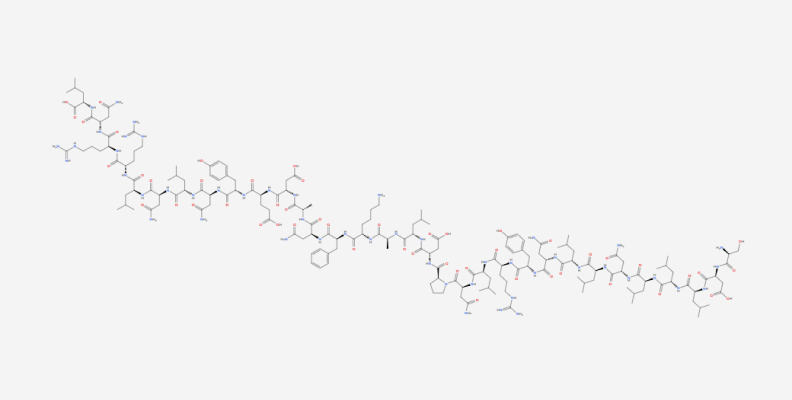
| Target Molecule | Teriparatide (PTH 1-34) |
| Synonyms | Parathyroid Hormone (1-34) (human), hPTH(1-34), PTH 1-34, Forteo, LY333334 |
| CAS Number | 52232-67-4 (free base); 99294-94-7 (acetate salt) |
| Sequence (3-Letter) | H-Ser-Val-Ser-Glu-Ile-Gln-Leu-Met-His-Asn-Leu-Gly-Lys-His-Leu-Asn-Ser-Met-Glu-Arg-Val-Glu-Trp-Leu-Arg-Lys-Lys-Leu-Gln-Asp-Val-His-Asn-Phe-OH |
| Sequence (1-Letter) | SVSEIQLMHNLGKHLNSMERVEWLRKKLQDVHNF |
| Molecular Formula | C₁₈₁H₂₉₁N₅₅O₅₁S₂ |
| Molecular Weight | 4117.72 |
| Service Category | Custom Peptide Synthesis / CDMO Manufacturing |
| Synthesis Purity | Customizable (e.g., ≥95%, ≥98% via HPLC) |
| Appearance | White to off-white lyophilized powder |
| Counter Ion | Acetate (standard pharmaceutical salt), TFA, or custom options |
| Synthesis Technology | Solid-Phase Peptide Synthesis (SPPS) for Long-Chain Oxidation-Prone Sequences |
| Modification Options | Oxidation control, stable isotope labeling (13C, 15N), methionine-sulfoxide impurity standards, deletion sequence profiling |
| Available Scale | Milligram (R&D) to Kilogram (Commercial CDMO) |
| Analytical Data | Comprehensive COA, HPLC, MS, and purity verification provided per batch |
| Usage | Raw material synthesized strictly for laboratory research, analytical development, and industrial formulation. Not a finished medicine. |
Teriparatide (PTH 1-34, CAS 52232-67-4) is the active 34-amino-acid N-terminal fragment of human parathyroid hormone (SVSEIQLMHNLGKHLNSMERVEWLRKKLQDVHNF). We target this sequence to supply high-purity reference materials and raw materials for bone metabolism and osteoporosis research.
Assembling a 34-residue linear chain containing two methionines (Met8, Met18) and a tryptophan (Trp23) carries cumulative risks of sequence truncation and oxidative degradation. Our peptide synthesis platform utilizes optimized Solid-Phase Peptide Synthesis (SPPS) protocols on low-loading resins, high-efficiency coupling reagents, and inert atmosphere handling during cleavage to suppress oxidation and ensure high-fidelity chain elongation.
Yes. We provide specialized peptide modification services for parathyroid hormone derivatives. Options include site-specific stable isotope labeling (13C, 15N) for quantitative mass spectrometry (LC-MS/MS), fluorescent or biotin tagging, and the synthesis of specific oxidized methionine variants or deletion sequences as stability-indicating impurity standards.
Our manufacturing infrastructure scales production from milligram-level analytical batches to multigram and kilogram commercial quantities. We optimize preparative HPLC purification under anoxic conditions and controlled counter-ion exchange (ensuring acetate salt conversion) to guarantee strict batch-to-batch consistency.
We operate as an integrated technical partner providing complete peptide CDMO solutions. Our team manages sequence optimization, oxidation suppression, impurity profiling, analytical method validation, and regulatory documentation to support complex drug development pipelines.
Teriparatide, the 1-34 N-terminal active fragment of human parathyroid hormone (CAS 52232-67-4), historically commercialized under the brand name Forteo, is a synthetic 34-amino-acid peptide acting as a potent anabolic bone agent. Defined by the sequence SVSEIQLMHNLGKHLNSMERVEWLRKKLQDVHNF, it stimulates bone formation through intermittent receptor activation. Synpeptide delivers comprehensive custom synthesis solutions for this target molecule, showcasing our technical capabilities in long-chain SPPS, oxidation control, and CDMO manufacturing.
Constructing a 34-residue sequence requires exceptional coupling efficiency across numerous cycles to prevent cumulative deletion errors and on-resin aggregation. Our custom peptide synthesis platform resolves these hurdles using optimized Solid-Phase Peptide Synthesis (SPPS) protocols on low-loading resins. By deploying high-efficiency coupling reagents, temperature control, and rigorous cycle monitoring, we suppress truncated byproducts, delivering raw materials with rigorous purity specifications (typically ≥95% or ≥98% via HPLC).
The sequence of Teriparatide contains vulnerable residues—specifically Met8, Met18, and Trp23—that are highly susceptible to oxidation during synthesis, cleavage, and purification. Through our peptide modification services, we protect vulnerable residues using anoxic handling procedures and customized scavenger systems. Furthermore, we synthesize defined methionine sulfoxide variants and truncated fragments as reference standards, and offer stable isotope labeling (13C, 15N) for pharmacokinetic tracking.
Transitioning a long, oxidation-sensitive peptide from laboratory research to commercial scale demands robust chemical engineering during downstream chromatographic isolation. We execute large-scale peptide synthesis for Teriparatide by optimizing anoxic fluid dynamics and high-capacity preparative HPLC purification. Our facilities accommodate requirements from milligram research batches to kilogram commercial lots, ensuring uniform counter-ion exchange (consistently achieving the pharmaceutical acetate salt form) and consistent lyophilization profiles across all production volumes.
We deliver comprehensive technical support as a fully established peptide CDMO. Our development specialists assist pharmaceutical partners with process optimization, stability testing, impurity identification, and analytical method validation. Every batch is released with complete documentation—including COA, HPLC purity traces, and exact mass confirmation—ensuring regulatory alignment for downstream clinical-stage programs.


